

[ad_1]
As customer interactions shift almost exclusively to digital environments, digital experience management (DXM) has evolved from a desirable marketing strategy to a crucial operational framework.
According to our State of Customer Experience Report, businesses that bank on data to personalize digital journeys are seeing a significant increase in customer lifetime value (CLV) and brand loyalty. This guide will show you how to optimize your digital customer journey, which technical components are essential for success, and how to thrive in an AI-driven market.
Take the AI Maturity Assessment
In just 5 minutes, get your personalized score and recommendations to move forward with AI.
What Is Digital Experience Management?
Digital experience management (DXM) is the coordinated discipline of monitoring and optimizing a user’s digital interactions with a brand. Although often associated with marketing, it’s a cross-functional strategy that unites IT performance, customer support, and product design toward a single goal: creating a seamless customer journey.
DXM helps connect different digital touchpoints. It includes managing a customer’s entire digital journey, from a social media ad to a mobile landing page, an AI-powered chat, and a post-purchase SMS notification, all the way to receiving the product.
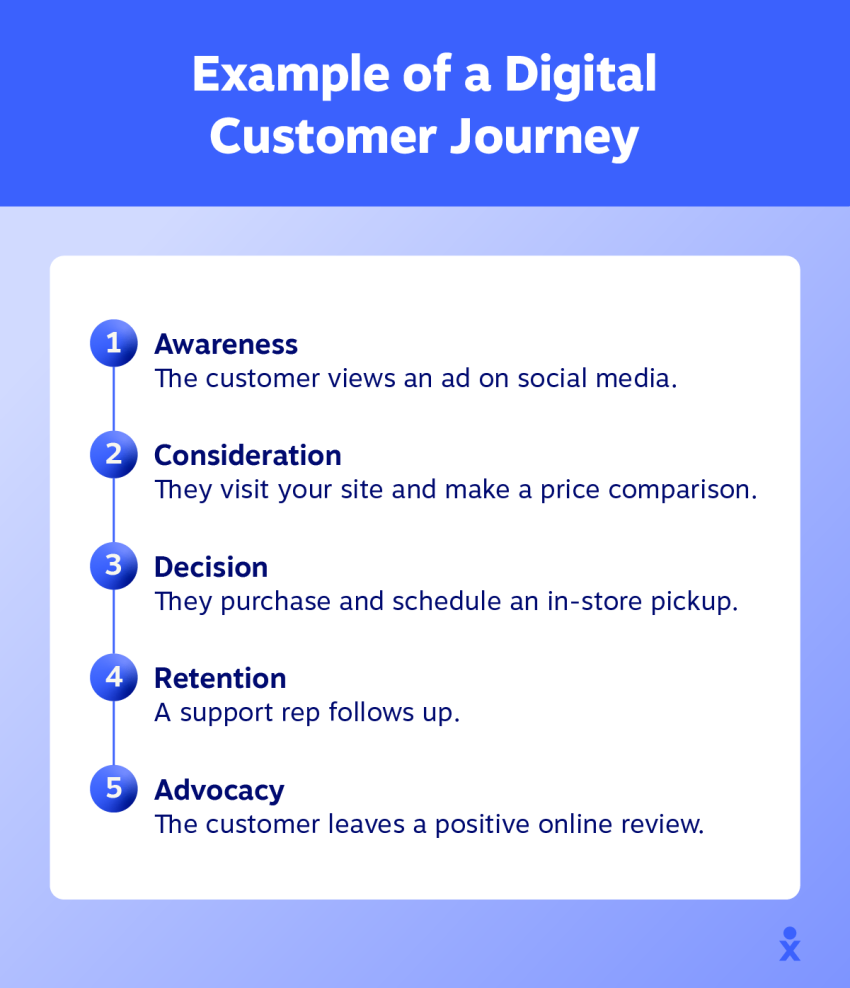
Digital Experience (DX) vs. Customer Experience (CX)
DX and CX are commonly confused and used interchangeably. Customer experience is the larger customer ecosystem, while digital experience represents the ecosystem of the water itself.
Customer experience covers the entire relationship between a customer and a brand, including offline interactions such as in-store purchases, hardware packaging, and traditional phone support. It’s the sum of all touchpoints across the customer lifecycle.
Digital experience is a specialized subset of CX that focuses exclusively on the digital interface. It captures a user’s digital journey with a brand through software and screens.
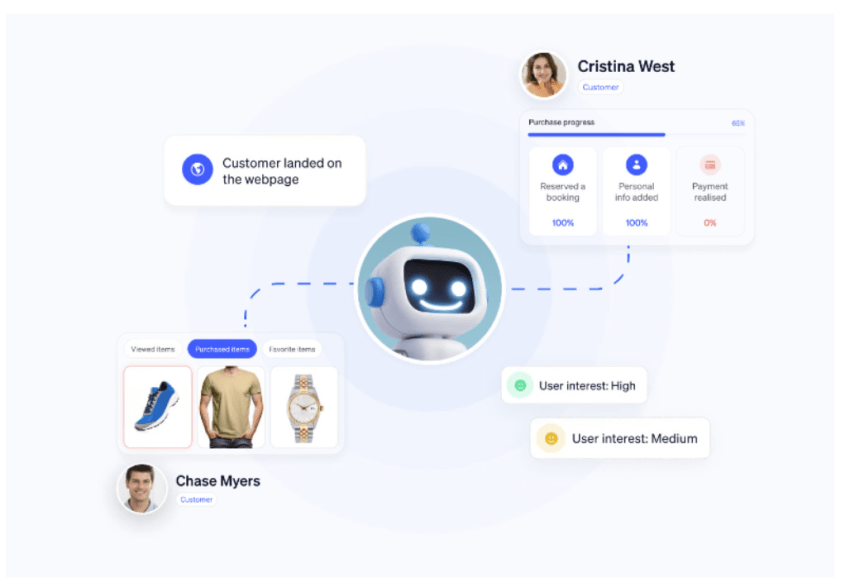
This distinction is key for resource allocation. A business may have a market-leading product (high CX value), but if the digital onboarding process is fragmented or slow (low DX value), the business will experience high customer churn rates before the customer fully realizes the product’s benefits.
DXM vs. DEX: Aligning External and Internal Experiences
To develop a solid digital experience strategy, also consider the digital employee experience (DEX). The digital experience of your employees through the tools they use and the quality of the customer experience are closely linked.
Digital experience management focuses on the external customer journey. Key goals include improving conversion rates, brand image, and customer lifetime value (CLV).
Digital employee experience focuses on the internal employee journey. Key goals include increasing employee productivity, reducing software impact, and lowering burnout.
| Feature | DXM | DEX |
|---|---|---|
| Primary user | Customers, leads, and subscribers | Employees, remote staff, and IT teams |
| Key objectives | User satisfaction, engagement and revenue growth | Efficiency and operational agility |
| Primary friction | Broken links, slow load times, or confusing navigation | Disconnected apps, data silos, or slow CRM response times |
| Business impact | Lower acquisition costs and higher retention | Reduced overhead and faster time-to-resolution |
When internal teams work with fragmented tools, customers experience the resulting delays. For example, if a support representative has to manually search three platforms to find a customer’s billing history (poor digital experience), the customer experiences slower and less professional interaction (poor digital management).
Unifying these internal tools, for example, with customer experience management software like Nextiva, will help businesses improve digital employee experience, which in turn positively impacts the customer experience.
Why Is Digital Experience Management Important?
In the digital realm, the quality of a user’s experience helps differentiate brands. Customer experience leaders should see DXM not as a cost factor, but as a key to increasing customer loyalty and optimizing day-to-day operations.
Here are some of the reasons why you need a DXM strategy:
1) Retention and customer lifetime value (CLV)
Acquiring new customers is more expensive than retaining existing ones. High-quality digital management reduces obstacles like long loading times or complicated navigation, which lead to customer churn. An intuitive digital customer journey increases customer retention rates, improving their long-term value.
2) Brand differentiation and trust
In highly competitive markets, features and prices are similar across competitors. A seamless, high-performing digital experience then becomes a key brand attribute. Consistency across web, mobile devices, and support channels builds professional trust; a fragmented experience, on the other hand, shows a lack of internal coordination.
3) Operational scalability
Manual customer management isn’t scalable. An effective DXM strategy uses automation to handle high interaction volumes without linear staff increases. Answering routine inquiries via self-service and AI helps businesses focus on demanding, complex problem-solving.
4) Data-backed decision making
DXM provides a feedback loop with detailed data. When you observe digital user behavior, you can pinpoint exactly where interest wanes, so your management can make time-sensitive investment decisions based on actual user behavior, rather than internal departmental assumptions.
Key Components of a DXM Strategy
A working DXM strategy requires a synchronized tech stack that bridges the gap between marketing, IT, and customer service.
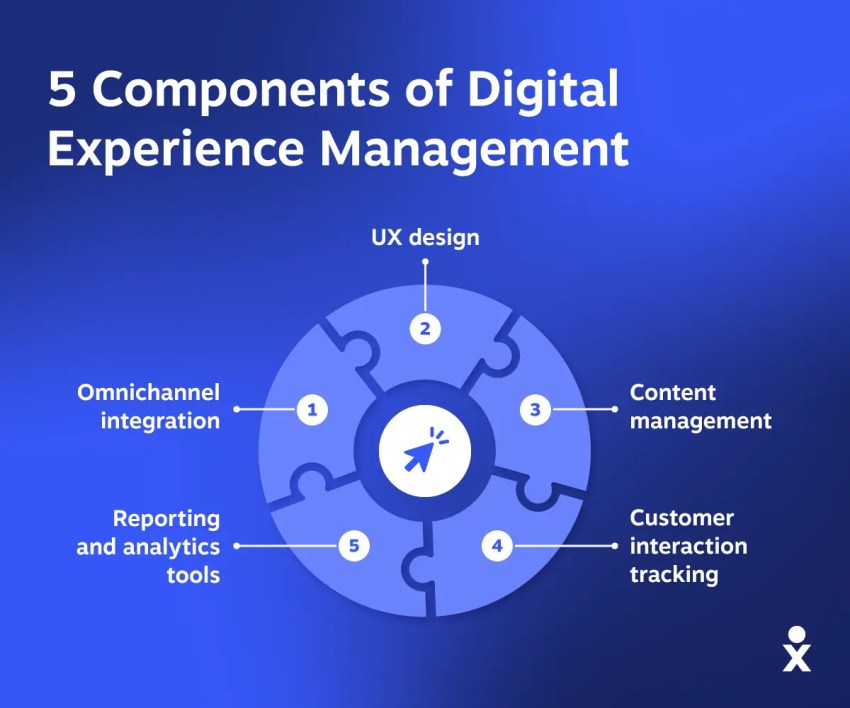
1) Omnichannel integration
At the very basic level, DXM should help maintain a consistent conversation across digital platforms. You’ll need:
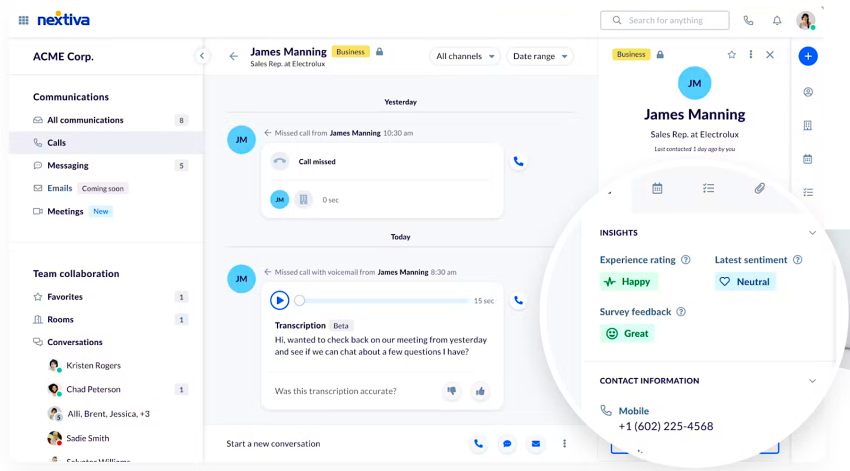
- Unified user interface: Employees should be able to manage SMS, WhatsApp, live chat, and email through a unified dashboard.
- Contextual history: The system should display the user’s previous interactions for the employee (or AI) to provide relevant support immediately.
2) Digital experience monitoring (DEMO)
DEMO focuses on your digital assets’ technical performance. DEMO involves:
- Real-user monitoring (RUM): Captures loading times and errors that visitors experience in real time.
- Synthetic testing: Automated scripts test your website or app around the clock so that your critical processes (like checkout or login buttons) function flawlessly.
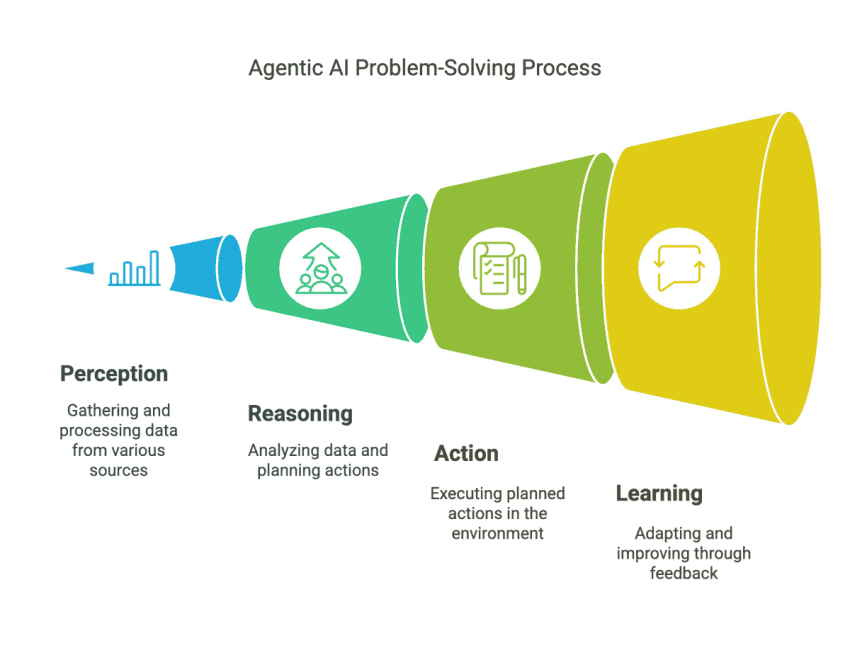
3) Conversational AI and agentic workflows
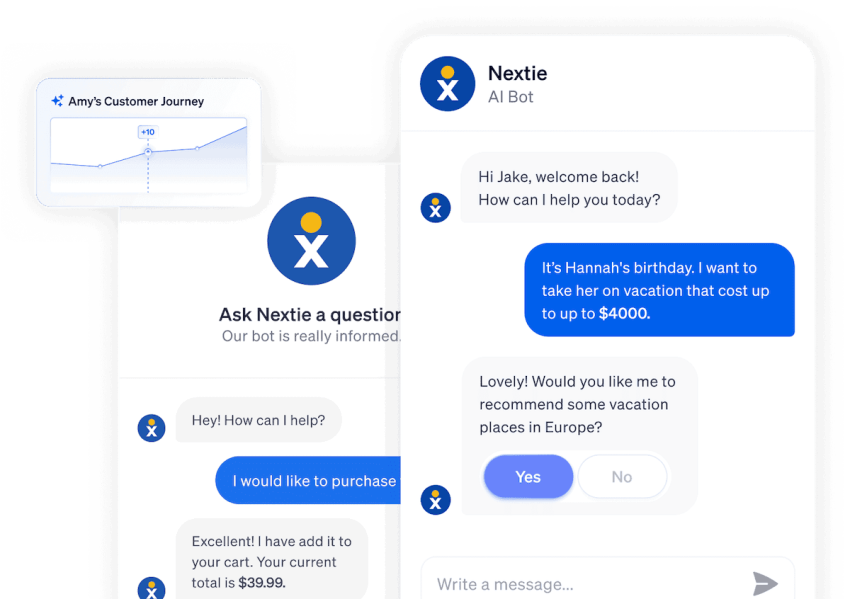
Artificial intelligence is the latest addition to DXM for managing customer interactions at scale. Some key AI technologies supporting DXM include:
- Intent recognition: Natural language processing (NLP) instantly identifies customer needs.
- Automated summarization: AI tools transcribe and summarize calls or chats for faster handoffs and improved management visibility.
4) Content and digital asset management (CMS/DAM)
To create a consistent brand identity, all digital assets, including images, technical documentation, and marketing copy, should be managed from one place. For example, your help center always provides the latest version of the product manual, and your web chatbot delivers accurate and up-to-date pricing information.
5) Reporting and sentiment analysis
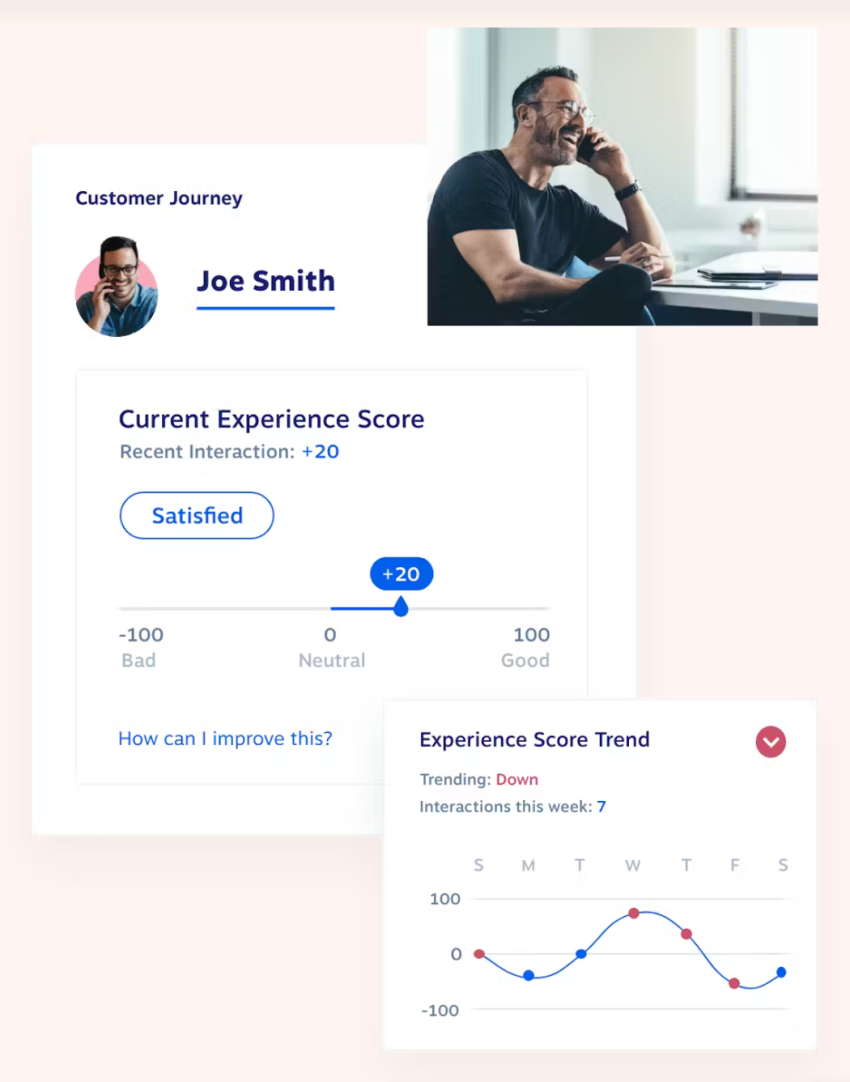
Besides simple clicks, a sophisticated DXM strategy captures user sentiment. Analyzing the tone of digital interactions enables businesses to identify customer dissatisfaction and proactively tweak their strategy. Real-time dashboards provide your management team with a continuous overview of your business’ digital health.
Top Benefits of Digital Experience Management
An efficient DXM strategy unifies communication and data, helping achieve both increased revenue and higher profitability. Here are some of the key benefits DXM brings to your business:
1) Increased operational efficiency
Manually managing digital channels is resource-intensive. DXM platforms streamline workflows by automating routine data entry and conversation tagging. When your communication tools automatically sync with your CRM, your employees spend less time on administrative tasks and more time resolving complex customer issues.
2) Higher conversion and retention rates
Friction is the biggest enemy of digital experience. Monitoring the customer journey helps businesses identify points of failure, say a confusing mobile checkout or a slow-loading pricing page. Eliminating these technical hurdles improves conversion rates. Personalized digital experiences also make customers feel understood, which, in turn, reduces customer churn.
3) Data-driven insights
DXM offers detailed insights into customer behavior that cannot be captured with traditional analytical methods. Analyzing conversations and sentiment enables management to identify emerging market trends or product weaknesses in real time, allowing them to proactively adapt their business strategy instead of reactively trying to mitigate damage.
4) Scalable personalization
AI-powered content and product recommendations enable businesses to offer several users a personalized experience simultaneously. Customer experience personalization means each user receives the information most relevant to their needs, which increases the likelihood of a successful purchase.
Common Pitfalls of DXM
While the advantages are clear, to implement a DXM strategy, you need to overcome several structural and technical challenges, including:
1) Persistent data silos
One of the biggest obstacles to delivering an exceptional digital experience is fragmented data. If information from a web chat isn’t available to a support representative during a phone call, the customer has to submit their request again. To avoid this, you need a unified customer experience management (UCXM) platform that centralizes interaction data across departments.

2) Addressing technology fragmentation
Many companies suffer from the complexity of their existing, sometimes incompatible, applications. This leads to high licensing costs and technical debt. Switching to a central digital experience platform reduces this complexity and aligns all tools toward a common goal.
3) Maintaining scalable performance
With increasing digital traffic, guaranteeing short loading times and 100% availability is challenging. Without a dedicated DEMO, technical issues can go unnoticed for hours. You can end up losing revenue and suffering irreparable reputational damage.
4) Combining automation and human interaction
Finding the right balance between AI bots and human support is a common challenge. Heavy automation adds to customer frustration, while too little can result in high operating costs. A successful DXM strategy uses AI to handle routine tasks while having a human expert always available for complex or critical customer queries.
To implement a DXM strategy, you need a tech stack covering customer communication, data, and performance monitoring. While specialized, standalone solutions exist, unified digital experience platforms minimize integration efforts.
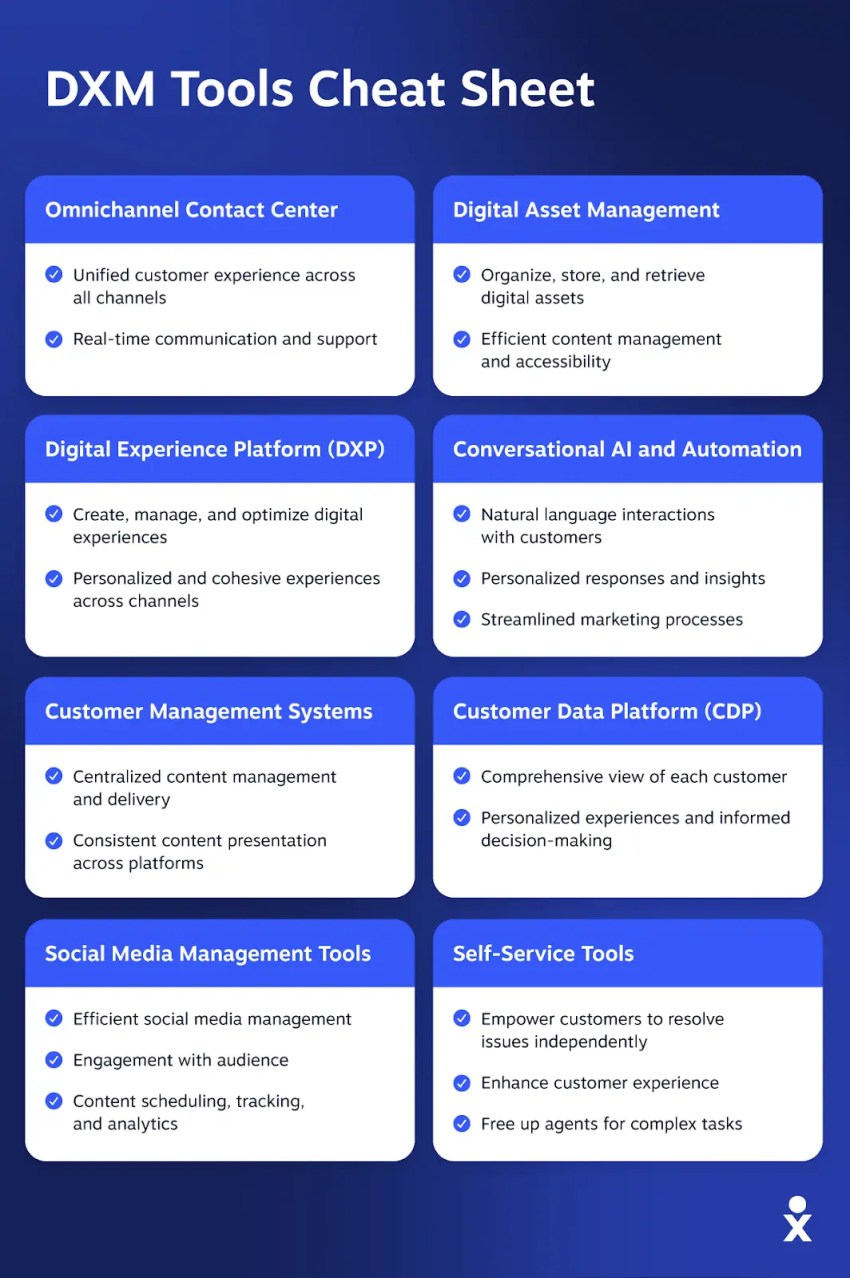
You need:
- Omnichannel contact center: Combine telephony, email, SMS, and social media into a single user interface. Your employees have access to the complete call history, no matter how the customer contacted you.
- Digital experience monitoring: Tools for monitoring technical health, such as page load times, API availability, and click behavior (heatmaps).
- Customer data platform (CDP): A central database that aggregates data from your website, CRM system, and marketing tools, giving a 360-degree view of each customer.
- Content management systems (CMS): These help create and distribute digital content across digital channels, helping maintain a consistent brand image.
- Conversational AI and self-service: AI-powered chatbots and knowledge bases that allow customers to solve routine problems (like tracking an order or resetting a password) without human support.
Implementing a DXM Strategy
Transitioning to a mature DXM model doesn’t happen overnight. Use this phased approach to align your tech and operations:
- Review your current digital journey: Identify every digital touchpoint — from social media presence to after-sales support. Use analytics to find drop-off points where users abandon the funnel. Is it a technical error or a confusing user interface?
- Unify your communication channels: Consolidate your previously separate tools. Implement a unified communications platform like Nextiva for seamless data flow between your team and your customers.
- Implement experience monitoring: Use monitoring tools to identify problems, such as slow page loading for users in a specific region or mobile app crashes after an update. Proactive monitoring helps resolve issues before they negatively impact your customer satisfaction scores.
- Use AI and automation: Identify the most frequent customer inquiries. Use conversational AI to automate handling these tasks. You’ll free up your employees for challenging interactions that require empathy and complex problem-solving.
- Measure, iterate, and scale: Connect your digital metrics (like page load time or chat response time) to business outcomes (like conversion rate).
Enhance Your Digital Experience Management Strategy with Nextiva
Effective digital experience management requires more than just a good UX design; it demands a powerful communications infrastructure. Nextiva’s unified customer experience platform eliminates the technical hurdles that obstruct the customers’ digital journey.
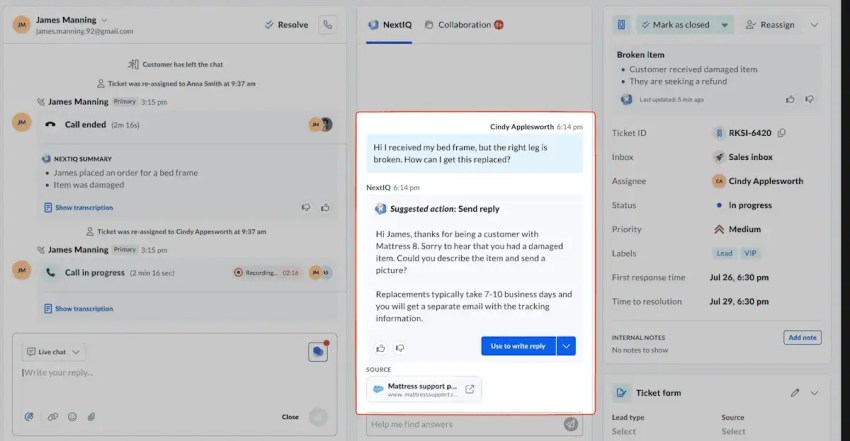
Nextiva consolidates your digital touchpoints into a unified interface, giving you tools like:
- Omnichannel integration across all plans: Whether Core, Engage, or Power Suite, Nextiva keeps your digital communications, including telephony, business SMS, and team chat, unified. Your employees get to deliver consistent brand communication across various digital channels.
- Advanced orchestration: For businesses expanding their digital presence, Nextiva offers omnichannel engagement across web chat and telephony. It bridges the gap between digital and traditional channels and offers features like web and ACD callback to respect your customers’ time.
- AI-powered insights and transcription: Thanks to Agentic AI, the platform offers real-time dashboards and automated summaries. Customer experience managers get to better monitor user sentiment throughout the user journey and identify technical or service bottlenecks before they negatively impact customer satisfaction.
- Complete transparency: Your employees have access to full conversation history at any time to provide a personalized customer experience that boosts ROI. Nextiva reduces app switching and data silos, helping improve both the employee experience and the overall digital experience for your customers.
See how Nextiva can enrich your DXM strategy today.
Create an amazing digital customer experience.
Engage on every channel with Nextiva’s platform for the best customer experience.
Digital Experience Management FAQs
Here’s a brief overview of the key aspects of digital experience management.
Digital experience management, also known as DXM or DEM, focuses on the external customer or user journey. Digital employee experience (DEX) focuses on the internal digital environment, so employees have the fast, reliable, and integrated tools they need to stay productive.
A digital experience platform (DXP) is an integrated suite of digital technologies. For example, Nextiva provides a communications-led DXP that unifies customer engagement across voice and digital channels, while platforms like Adobe focus on content-led digital experiences.
A digital experience manager shapes the overall customer journey, including defining the UX strategy, managing buyer personas, and overseeing the technical integration of tools like CRMs, CMSs, and communication platforms.
[ad_2]
Source link