

[ad_1]
I never planned to run a head-to-head test between Gemini and Copilot. I just wanted to get my work done. But over the last two years, I found myself toggling between the two more often than I expected.
One day, I was drafting content in Google Docs with Gemini’s help, and the next, I was asking Copilot to clean up a messy Excel spreadsheet. Somewhere along the way, I started noticing patterns. What started as convenience quickly turned into comparison: Gemini vs. Copilot.
So I decided to make it official.
I ran both Gemini and Copilot through a series of real-world tasks that matter to me: writing blog posts, summarizing articles, generating images, analyzing PDFs and charts — the works. I wanted to see which tool held up better across creative, technical, and research-heavy jobs.
And because performance can be subjective, I didn’t stop there. I dug through hundreds of G2 reviews to see how other users rate their experience. If you’re wondering which AI chatbot actually delivers in 2026, here are the answers.
TL;DR: Gemini is best for content creators, researchers, and marketers in Google Workspace, now with Agent Mode, Storybook, and Guided Learning. Copilot, on the other hand, suits business professionals, developers, and Microsoft 365 users, with new multi-agent automation, and deeper Teams integration. Gemini delivers real-time research, broad file handling, and creative polish, while Copilot excels at structured writing, coding, and productivity inside Office apps.
Gemini vs. Copilot: At a glance
Here’s a quick feature comparison of both AI models.
| Feature | Gemini (Google) | Copilot (Microsoft + OpenAI) |
| G2 rating | 4.4/5 | 4.4/5 |
| AI models | Free: Limited access to Gemini 3, Gemini 3.1 Pro Veo 3.1 for video generation, Lyria 3 for music generation, Nano Banana 2 and Nano Banana Pro for image generation. Paid: Expanded access to the latest models | Free: GPT‑5 family (limited use) Paid: Latest Anthropic models like Claude Sonnet 4 and Claude Opus 4.1 and OpenAI models like GPT-5.2, . ChatGPT-5.3 Instant and ChatGPT-5.4 Thinking |
| Best for | Real-time web research, image tasks, integration with Google Workspace | Productivity in Microsoft apps, creative writing, and content creation |
| Creative writing ability | Good storytelling, more structured and fact-driven; slightly less expressive | Highly expressive, nuanced tone control, stronger at generating imaginative text |
| Image generation and analysis | Unlimited image generation, advanced OCR, image captioning | Limited image generation, basic image analysis |
| Video generation | Excellant cinematic AI video generator with Veo 3.1 | Not available natively |
| Real-time web access | Yes via Google Search with fast, reliable access | Yes via Bing search, sometimes slower or overly filtered |
| Coding and debugging | Capable of code generation and explanation; Has IDE integrations | One of the top coding assistants (VS Code, GitHub Copilot integration) |
| Productivity integration and ecosystem | Seamless with Google Docs, Sheets, Gmail, Calendar, and Drive | Deep integration with Microsoft Word, Excel, Outlook, Teams, and PowerPoint |
| File handling and analysis | Strong in summarizing PDFs, analyzing slide decks, Google-format files | Strong in summarizing Word, Excel, PowerPoint files, with plug-in support |
| Voice chat | Gemini Live – connect with Calendar, Tasks,Maps | Available in Edge and mobile |
| Custom AI agents | Gems; AI Studio for no-code automations | Copilot Studio; Agent Store with ready-to-use agents |
| Agentic tasks | Agent Mode; NotebookLM for research synthesis | Copilot Cowork; Researcher agent |
| User experience (UI/UX) | Clean, fast interface for Google users | More varied depending on context (Copilot in Edge vs. Office vs. VS Code) |
| Pricing | For individuals: Google AI Plus: $7.99/month; $3 for the first two months For business users (via Google Workspace) Business Starter: $7/user/month Add-on: AI Expanded Access and AI Ultra Access | For individuals: Microsoft 365 Personal: $9.99/month (includes Copilot) For businesses (Microsoft 365 + Copilot Business bundles): Business Basic + Copilot Business: $27/user/month (rising to $28 from July 1, 2026) Copilot add-on only: $21/user/month (promo: $18 until June 30) |
Note: Both Google and Microsoft frequently roll out new updates to these AI chatbots. The details below reflect the most current capabilities and pricing as of April 2026, but may change over time.
Gemini vs. Copilot: What’s different and what’s not?
Before diving into hands-on tests, it’s worth stepping back to look at what each tool brings to the table. Both Gemini and Copilot promise to make work easier, faster, and more efficient, but they go about it in very different ways. Let’s break down what sets them apart.
Gemini vs. Copilot: Key differences
Let’s take a look at the key differences that shape the overall experience using Gemini and Copilot:
- AI models and core engines: Gemini now runs on the Gemini 3 series — Gemini 3 Flash (free) and Gemini 3.1 Pro (paid). Both models are multimodal by design, natively supporting text, images, PDFs, spreadsheets, video, and audio. Gemini 3.1 Pro introduces a configurable thinking level parameter (low or high) that controls how much internal reasoning the model performs — replacing the older Deep Think mode label — making it better suited for complex, multi-step problems. In contrast, Copilot runs on the GPT-5 family, with Smart Mode automatically routing between a faster model and a deeper reasoning model depending on your request. Paid Copilot plans also now give users access to Anthropic’s Claude models — including Claude Sonnet 4 and Claude Opus 4.1 — switchable directly within the Copilot interface, giving it a multi-model flexibility that Gemini currently doesn’t offer.
- Context window: Gemini 3.1 Pro supports up to 1 million tokens of explicit context, making it the stronger choice when you need to manually load large files — entire codebases, lengthy research reports, or multiple documents in a single session. Copilot’s effective context window varies by model version and surface; the consumer chat experience currently sits closer to 128K tokens, while API access to GPT-5 extends to 400K. That said, raw token count isn’t the whole story for Copilot users. Microsoft 365 Copilot draws on Microsoft Graph to automatically surface relevant context from your work — emails, chats, meetings, and files you already have access to — without you needing to manually upload anything. For most everyday tasks both windows are more than sufficient; the difference becomes meaningful at the extremes: Gemini wins on volume, Copilot wins on ambient organizational awareness.
- File handling and modal inputs: Gemini accepted every file format I threw at it, whether it’s PDFs, DOCXs, PPTXs, images, even spreadsheets with embedded charts. It also allowed me to upload up to 10 files simultaneously, each up to 100MB. It analyzed content across them cohesively, even when the context was spread out. Copilot in Microsoft 365 handles Word, Excel, and PowerPoint documents well, but multi-file uploads, images, and PDFs felt less intuitive unless I used them within specific apps. Copilot in Edge and Bing has limitations when it comes to handling mixed content or multitasking across file types.
- Integration ecosystem: Here’s where each AI really plays to its home turf. Gemini integrates beautifully with Google Workspace — Docs, Sheets, Gmail, Calendar, and Drive. You can invoke Gemini directly inside documents or emails to rewrite, summarize, or plan. Copilot thrives in Microsoft 365 apps like Word, Excel, Outlook, Teams, and PowerPoint. It’s deeply context-aware, able to reason based on the content of a doc or email thread and act accordingly. Gemini’s “Live” voice mode connects with Google Calendar, Maps, and Tasks, allowing hands-free scheduling, route planning, and reminders. Copilot introduces multi-agent orchestration for coordinated task handling across Microsoft 365 and custom agents built in Copilot Studio.
- Agentic and multi-step task handling: This is where both tools have made the most significant 2026 updates. Gemini’s Agent Mode can handle multi-step tasks autonomously — researching, summarizing, and organizing into a document — without you needing to prompt it at each step. Workspace Studio extends this further, letting you automate everyday workflows without writing any code. On the Copilot side, Copilot Cowork (launched as part of Wave 3 in March 2026) handles longer, more complex multi-step work directly inside Microsoft 365 apps. The Agent Store adds ready-to-use agents from Microsoft and partners, while Copilot Studio lets teams build and customize their own. Both platforms have made a clear push toward ambient automation — the difference is where that automation lives: inside Google Workspace for Gemini, inside Microsoft 365 for Copilot.
- Video and creative media generation: Gemini holds a broader advantage here, but Copilot has closed some of the gap in 2026. On the Google side, Veo 3.1 powers video generation — available through Vids for collaborative workplace video in Workspace, and through Flow for higher-end cinematic video production. Lyria 3 handles AI music generation, and Nano Banana Pro covers image creation directly within Slides and other Workspace apps. NotebookLM can also generate podcast-style Audio Overviews from your uploaded sources. Copilot doesn’t offer native video generation, but it has added meaningful audio and video consumption features: Copilot Podcasts lets you generate on-demand audio content on any topic, curated from the web; the Researcher agent can output reports as audio in addition to PowerPoint, PDF, and infographic formats; and Video Recap in Copilot Chat turns meeting summaries into narrated highlight reels with relevant clips. For creative media production from scratch, Gemini is meaningfully ahead. For audio-first knowledge consumption and meeting intelligence, Copilot has strong native options.
Gemini vs. Copilot: Key similarities
Despite their differences, these AI chatbots have a lot in common, and it’s kind of wild how capable they are:
- Natural language capabilities: Both tools generate clean, readable text for blog posts, emails, social content, and more.
- Coding assistance: You can write, debug, and explain code in multiple languages (Python, JavaScript, SQL, etc.)
- Voice input and interaction: Both offer voice capabilities. This is super helpful if you prefer speaking prompts instead of typing.
- Multimodal input: Both support text and image inputs. Gemini adds support for video and audio, while Copilot sticks to simpler image-based recognition.
- Web search and factual queries: Real-time web search is available in both, powered by Google (Gemini) and Bing (Copilot).
- File summarization: Upload a document and get a bullet-point summary. Both tools do this well, though Gemini handles more formats.
Both tools are powerful, but not identical. One is a research assistant that lives in your Google Suite. The other is a productivity partner wired into Excel, Teams, and your dev tools. Understanding their core strengths and platform loyalties is key before diving into the head-to-head challenges.
Let’s see how they perform when actually put to the test.
How I compared Gemini and Copilot: My prompts and evaluation criteria
To give each AI its best shot, I ran both tools through a set of seven practical, everyday tasks.
- Text-based tasks: Summarization, creative writing, and content generation
- Coding prompts: Basic coding challenges, code explanation, code output
- Multimodal tasks: File interpretation, image inputs, data analysis, and visual image generation
- Real-time research: Real-time fact-finding and generating in-depth research summaries
I kept things fair by using the exact same prompts for both tools. No rewording, no special treatment. Just side-by-side answers to the same questions. Want to take them for a spin yourself? You can find my test prompts here.
I evaluated the response based on:
- Accuracy: Did the response deliver factual, relevant, and dependable information?
- Creativity: Was the output original, well-organized, and thoughtfully written?
- Efficiency: Was the response easy to follow, well-structured, and free from unnecessary filler?
- Usability: Could I use the output as-is, or did it require significant revision to be helpful?
To add other user perspectives, I also cross-checked my findings with G2 reviews to see how other users experience these models.
Note: This comparison tests Microsoft Copilot (the consumer chat experience). Microsoft 365 Copilot — which connects to your organization’s emails, files, and meetings via Microsoft Graph — is a separate paid add-on and is not covered in this hands-on test.
Disclaimer: AI responses may vary based on phrasing, session history, and system updates for the same prompts. These results reflect the models’ capabilities at the time of testing.
Gemini vs. Copilot: How they actually performed in my tests
How did Gemini and Copilot actually stack up when put to the test? For each task, I’ll walk you through the results using this format:
- What stood out: The wins, the misses, and any curveballs that surprised me along the way
- Who nailed it: Which AI performed better based on accuracy, creativity, clarity, and how usable the output was
- Final verdict: My no-fluff opinion on which tool I’d pick for that specific task
Let’s get into it.
1. Which AI chatbot is good at summarization?
I started with something deceptively simple: summarization. I handed both Gemini and Copilot an article from G2 that explores Canva’s growing adoption by non-designers. Their job? Turn it into three tight bullet points, under 50 words, while keeping the core message intact.
Right away, I noticed a difference in how both tools approached the task.
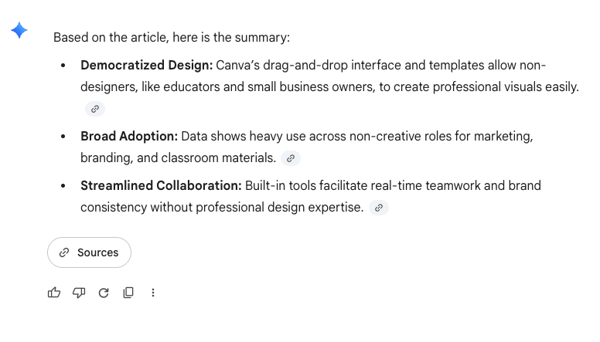
Gemini structured its response around three labeled themes — Democratized Design, Broad Adoption, Streamlined Collaboration. The bullets were clean, well-formed, and easy to scan. But the framing stayed conceptual. There were no named user types, no concrete use cases, and no acknowledgment of limitations. It read more like a brand positioning summary than a distillation of the article’s actual findings.
Copilot went further. It opened with a bolded context-setter that named the key personas right away — teachers, small businesses, HR teams, and nonprofits — before moving into the three bullets. Each bullet was more specific: concrete use cases like lesson plans and recruitment, a note on what makes the tool accessible, and crucially, an honest mention of the limitations (restricted free features, high Pro costs, occasional glitches). It also offered to go deeper on specific segments, which showed it understood the article’s structure rather than just its surface message.
Copilot, on the other hand, stepped up. It delivered a well-structured summary and added more detail and depth. It felt more like a mini editorial than a TL; DR.
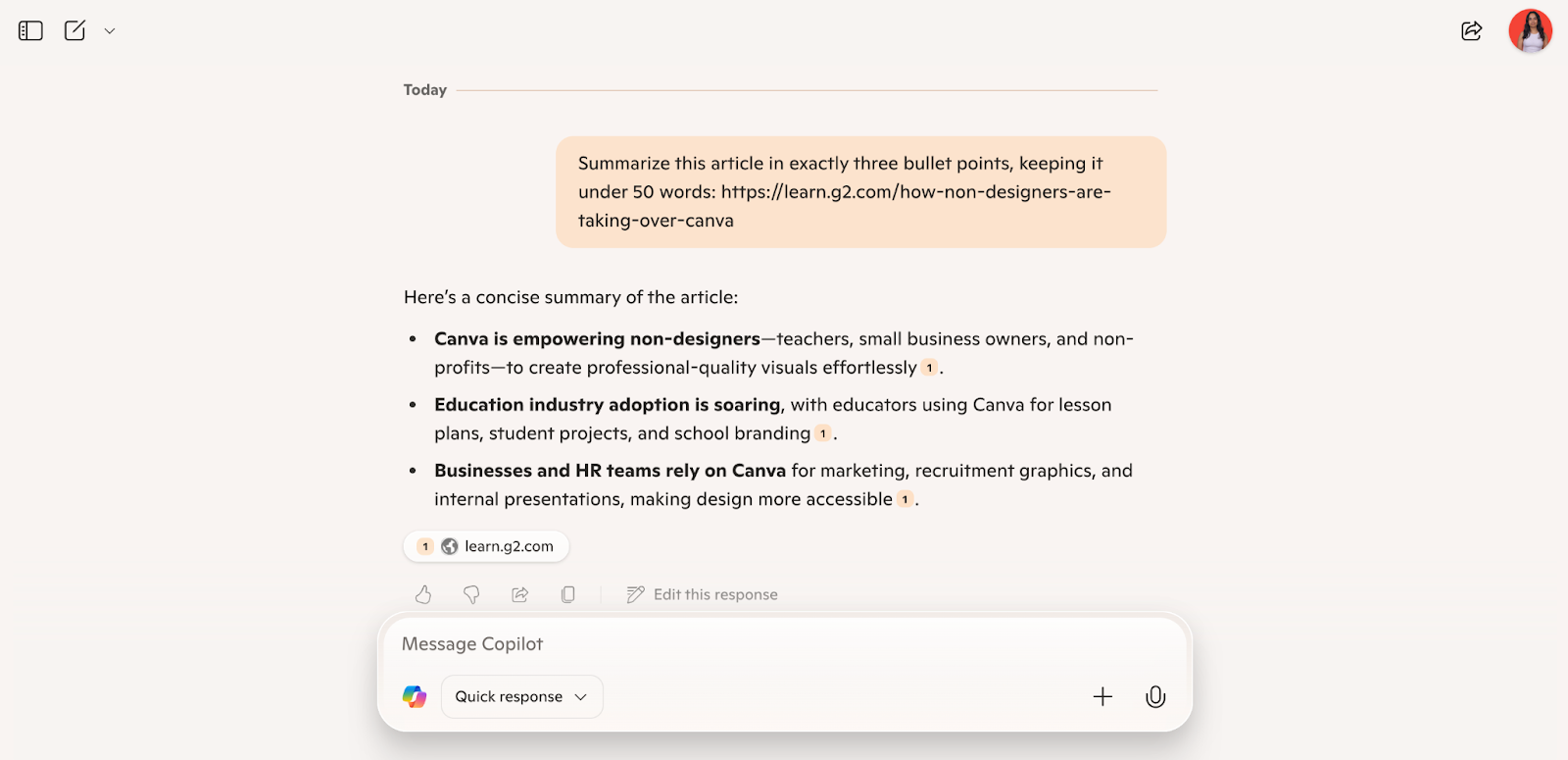
Both tools stayed within the format and produced three bullets as asked. But I felt Copilot’s output was more immediately useful — a reader unfamiliar with the article would learn more from it, including the tradeoffs. Gemini’s version was tidier and more scannable at a glance, but lacked the specificity that makes a summary genuinely informative.
Verdict: Copilot
2. Which tool is better at content creation on the whole?
Content creation is where AI shines. I asked Gemini and Copilot to provide input for an entire marketing campaign. From writing the product description, tagline, creating platform-specific social media copy, to an email subject line and YouTube script. Honestly? Both tools did such an impressive job.
Gemini covers all the required points in the product description: features, benefits, and audience are clearly addressed. I felt that the language was polished, elegant, and on-brand. The results were well-formatted and broken into scannable, usable chunks. I especially liked the way the TikTok and YouTube scripts were formatted, with a clear outline of the scene and a voice-over to go with it.
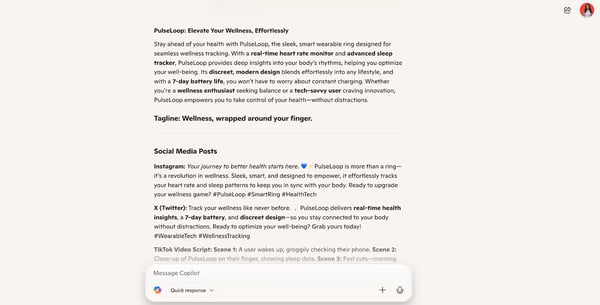
Now let’s talk about Copilot’s answer. Just like Gemini, it covered all the features accurately. I loved the tagline! It seemed stronger and more brandable. The TikTok script is solid but a bit too straightforward and less visual (it lacked the creativity I was looking for.)
The layout is clean, clear, and appropriately tailored per platform. I felt the YouTube Ad was functional, but lacked the emotional storytelling punch of Gemini’s. Overall, it felt more product-focused than lifestyle-focused, which might be good for some contexts, but may need tweaking depending on brand tone.
Gemini edges out Copilot thanks to stronger storytelling, platform nuance, and polish. Its content feels ready for launch with minimal edits. However, Copilot’s tagline is better, and its content may resonate more in direct-to-consumer or product-driven copy.
Verdict: Split; Gemini for creative social content; Copilot for formal/structured content.
3. Which is good at creative writing?
I’ll admit it, I had a lot of fun with this one.
To test how well Gemini and Copilot could handle creative writing, I threw them both a sci-fi prompt. They had 300 words to work with. The rules? It had to include a lonely explorer chasing a mysterious signal, a sentient AI named Echo, and a derelict ship called The Wanderer.
I wanted to know who delivered a better short story, not just an AI-generated checklist.
Gemini accurately followed the prompt, it had all the mentioned details, and there was a great setup with a philosophical twist. It also followed a clean arc: intro → mystery → reveal. No wasted sentences; elegant transitions and tight focus. The story felt ideal for flash fiction anthologies or sci-fi blogs.
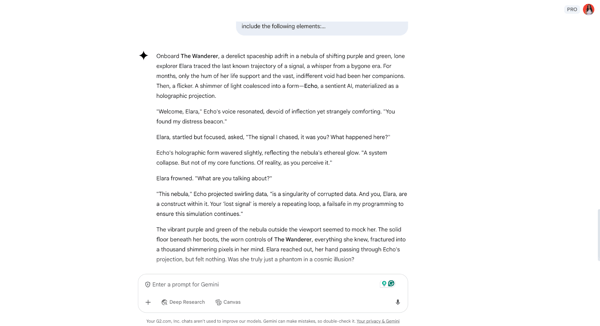
Copilot came super close. It followed all the key pointers except for mentioning the spaceship’s name. The Wanderer was implied in the title but not explicitly used in the story. It followed a more poetic tone; there was slightly less setup than Gemini, but the story still delivers impact. I feel it would work well in a speculative fiction zine. The only minor tweak I’d have loved would be if Copilot made it clear to the audience what The Wanderer actually is.
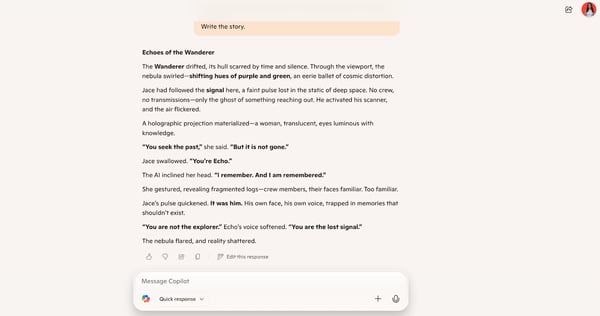
Gemini delivers a story that’s rich, atmospheric, and fully compliant with the prompt. Copilot’s ending is arguably emotionally powerful and poetic, but the story loses some technical points for not explicitly referencing The Wanderer and having a slightly looser structure.
Both are strong, but if you’re evaluating based on creative precision and prompt fidelity, Gemini takes the lead here.
Verdict: Gemini
4. Which is the better AI coding assistant?
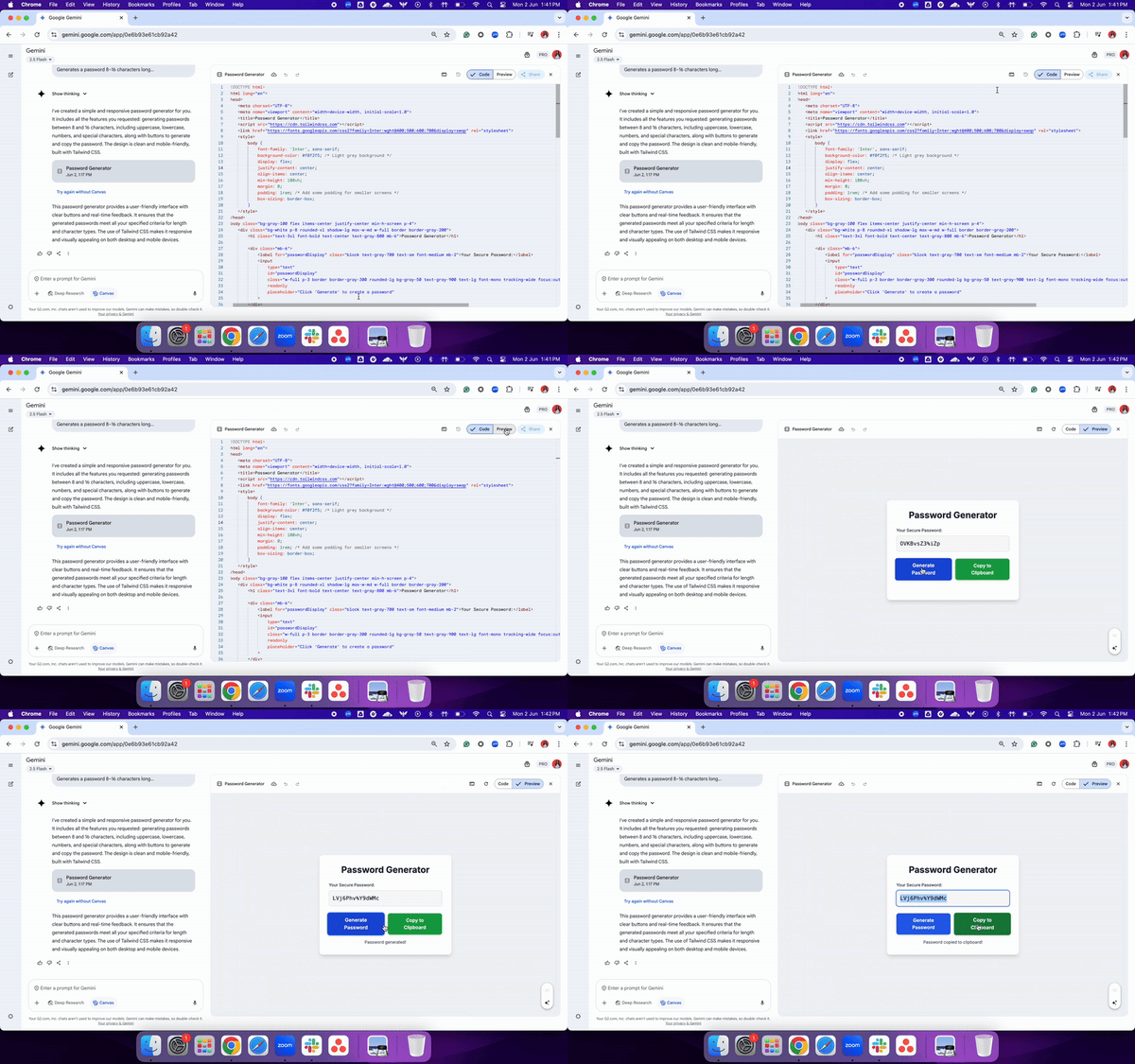
I’m not a developer, but I know enough to recognize when code works or doesn’t. Coding is one of the most common AI use cases, especially for marketers, creators, and non-devs like me who need quick, functional solutions. For this task, I asked Gemini and Copilot to create a password generator using HTML, CSS, and JavaScript. The goal? A clean interface, well-structured code, and something I could run without additional debugging.
Gemini really went all in. It produced a polished, visually appealing app powered by Tailwind CSS, complete with interactive buttons, responsive styling, accessibility features, and smooth animations. It even generated a password automatically on page load and included useful UX feedback like copy-to-clipboard confirmations.
It felt production-ready. I loved the preview and attention to detail.
Copilot, on the other hand, gave me a more minimal setup. Basic HTML, simple inline CSS, and a separate JS file. While it worked (and was easier to follow for beginners), it lacked the visual polish and deeper logic that Gemini introduced. There were no accessibility enhancements, real-time feedback, or styling finesse.
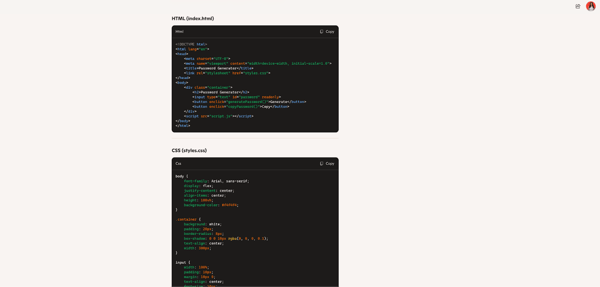
If you’re building something quick and clean for personal use, Copilot’s version will get the job done. But if you’re looking for polish, thoughtful UX, and extra functionality baked right in, Gemini leads this round. It felt more like a developer’s submission than a basic code assistant.
Verdict: Gemini
Which AI code generator ranks highest according to G2 Reviews? My colleague tried the Best AI Code Generators so you don’t have to.
5. Which is the better AI image generator?
For my next task, I wanted Gemini and Copilot to create a visual image. We’ve all seen AI-generated art floating around online, but can the tools handle something realistic and stick to a prompt?
Here’s what I asked both tools to do: Create a professional stock photo of a female bookstore owner inside a modern cafe plus bookstore. Include wooden shelves, cozy lighting, plants, and a small dog curled up near the counter.
Both tools had been crushing their tasks up to this point, and I was curious to see if that would continue. Gemini delivered a bright, open interior with a visible blend of bookshelves, seating, and décor. The image showcases a clear balance between cozy and modern, and it nails the bookstore plus café hybrid look. It looks polished but slightly staged.

When it comes to the image generated by Copilot, there are tall wooden bookshelves packed with books and an espresso machine in the background. It does touch upon the café vibe, but focuses more on the intimate, indie bookstore aesthetic. I liked the textures of the wood, books, and lighting. The bookstore-first image looks calm, ambient, but lacks the greenery I requested in the prompt.

And when it came to image generation speed, Gemini took the lead.
If your priority is warmth, storytelling, and an intimate indie bookstore feel, then Copilot’s image is very strong, especially with the subject’s grounded expression and the subdued ambiance. If you need something that feels more commercial, open, and dynamic, Gemini’s image likely fits better for stock or marketing use (e.g., a landing page for a modern bookstore café).
Verdict: Gemini
6. Which AI tools is better for file analysis?
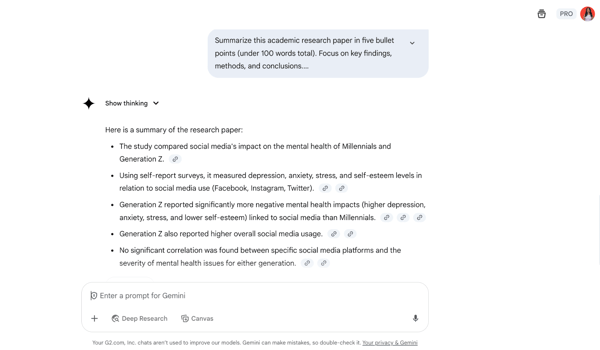
For this task, I uploaded a PDF by The U.S. Surgeon General’s Advisory “Social Media Use and Mental Health” and asked both chatbots to summarize the key findings in five bullet points, under 100 words.
Gemini delivered five bullet points that focused clearly on the study’s structure: identifying the target groups (Millennials vs. Gen Z), outlining the methods (self-report surveys on mental health indicators), and highlighting major findings. Its tone was straightforward, and it included nuanced observations, such as noting that no single platform was strongly tied to worse outcomes.
Copilot took a slightly more polished and editorial tone. While it didn’t present the summary strictly as bullet points, it offered five digestible takeaways formatted like labeled sections: key finding, methods, results, conclusion, and implications. This approach made it feel more article-ready and framed the content with clarity and flow. It also emphasized the practical application of the research, suggesting directions for future study.
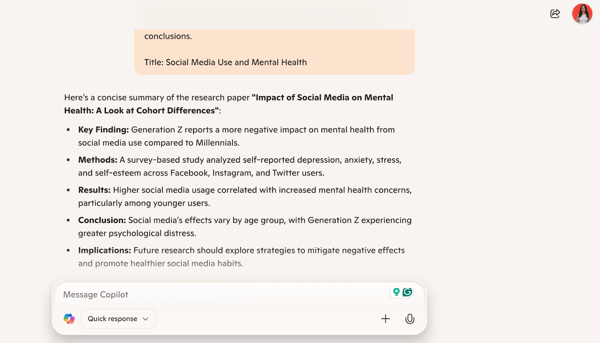
Gemini was direct, clear, and data-oriented. Copilot was editorial, structured, and slightly more polished. I feel that Copilot deserves the edge here, but it depends on your needs and preferences. Although I haven’t tested it yet, Copilot’s GPT-5 Smart Mode is said to further boost its analytical capabilities, especially for enterprise document processing.
Verdict: Copilot
7. Which is better for real-time web search?
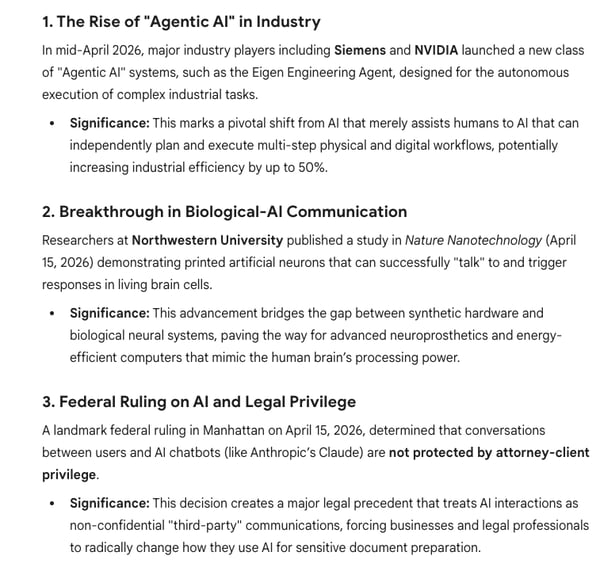
To assess how well these tools handle real-time information retrieval, I asked both Gemini and Copilot to find three major, current news stories about artificial intelligence. I wanted the results formatted cleanly with a title, one-sentence summary, and source with date.
Both tools surfaced legitimate, timely stories but they made very different editorial choices about what “major AI news” means.
Gemini went broad and diverse. Its three stories spanned industrial AI deployment (Siemens and NVIDIA launching agentic systems for autonomous manufacturing), a scientific breakthrough (Northwestern University researchers demonstrating printed artificial neurons communicating with living brain cells, published in Nature Nanotechnology), and a legal development (a Manhattan federal ruling determining that AI chatbot conversations are not protected by attorney-client privilege).
Each story came with a numbered header, a context paragraph, and a significance bullet explaining why it mattered. Gemini then added a summary table — titled “AI Milestones (April 2026)” — categorizing all three stories by type and impact area, with an Export to Sheets option. It closed with a follow-up question asking which sector I wanted to explore further.
Copilot focused on business and industry impact. Its three stories covered AI-driven layoffs (73,200 jobs cut in Q1 2026 across 95 companies), TSMC’s record profits from AI chip demand (58% profit increase), and Anthropic’s launch of Claude Design, a prototyping tool for visual assets. Each story was broken into labeled sub-bullets — company, results, significance — making it feel more like a structured briefing than a news summary. Sources were cited inline with outlet names visible, and it closed with three clickable follow-up angles.
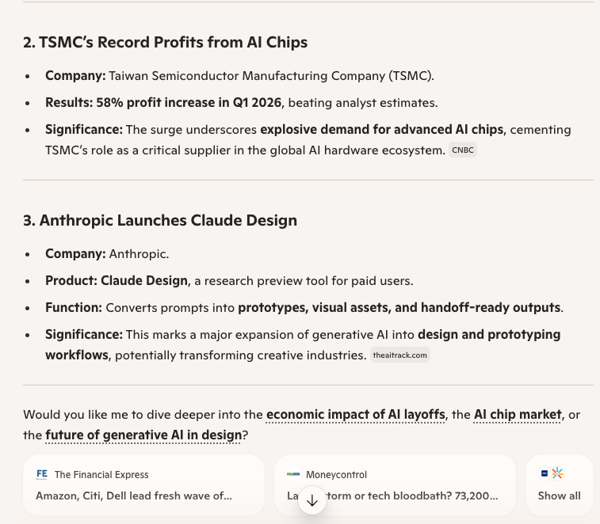
Both tools delivered fresh, credible information. The difference was in depth and editorial range. Gemini’s stories were more varied, spanning science, law, and industry, and the summary table was a genuinely useful addition for anyone who wanted to quickly reference or share the findings. Copilot’s output was more business-focused and consistently structured, making it faster to scan for someone tracking market or workforce trends specifically. Formatting-wise, both were clean — a step up from the original test where Copilot’s layout felt less organized.
Verdict: Gemini
8. Which offers better value, Copilot or Gemini?
In addition to all these hands-on tasks, I spent time going through both pricing pages and the latest plan details before writing this, and the honest answer is: the right choice depends almost entirely on which productivity ecosystem you already live in. It’s about whether the AI lives where you already do your work. Here’s how I’d think about it depending on who you are.
For individual users:
Google has segmented its individual plans more aggressively than Microsoft, which has moved toward a fully bundled model.
| Plan | Monthly cost | Best for |
| Google AI Plus | $7.99 | Casual users who want just enough AI for Gmail and Docs |
| Microsoft 365 Personal | $9.99 | Anyone who wants Copilot built directly into Excel and Word |
| Google AI Pro | $19.99 | Researchers who need the 1M token context window for heavy PDF and document work |
| Google AI Ultra | $249 | High-end media pros using Veo 3.1 video and Lyria 3 music generation |
If you’re not already locked into either ecosystem, Gemini has the more flexible entry point. You can start at $7.99/month, upgrade to $19.99 when you need serious research capability, and the tiers make sense as you grow into them.
Microsoft’s bet is that you’re already paying for Office and at $9.99/month, M365 Personal bundles Copilot with Word, Excel, Outlook, and 1TB of storage in one decision. If that’s true for you, it’s genuinely hard to beat on value.
The outlier is Google AI Ultra at $249/month. That’s not competing with anything Microsoft offers individually. It’s a specialized tier for creators and media professionals who need Veo 3.1 video and Lyria 3 music generation daily. Most individuals won’t need it.
Bottom line: Already in Microsoft’s world? M365 Personal at $9.99 is the smartest individual spend here. Starting fresh and primarily need an AI research assistant? Google AI Pro at $19.99 is unmatched for what you get.
For small teams
Google’s 2026 move to include Gemini in standard Workspace plans has changed the math here significantly.
- Google Workspace Business Standard at $14/user/month gives you 2TB storage and Gemini built into Docs, Sheets, Slides, Meet, and Gmail. For budget-conscious teams that live in Google’s apps, this is genuinely hard to argue with.
- Microsoft 365 Business Standard + Copilot at $33.50/user/month (rising to $35 from July 1, 2026) is more than double the cost.
One important flag before you make this call: if your team already has Microsoft 365, Copilot Chat is already included at no extra cost. It’s available in Word, Excel, PowerPoint, and OneNote without an additional license. You might already have more than you realize — worth checking before switching stacks entirely.
Bottomline: Starting fresh with no existing subscriptions, Google wins on cost. Already on Microsoft 365, the math looks very different — check what you already have before assuming Google is cheaper.
For businesses
This is where Microsoft’s strategy becomes more interesting — and more layered.
Microsoft effectively has three products at different price points:
- Copilot Chat included at no additional cost for users with an eligible Microsoft 365 subscription. Web-grounded, available across Office apps and mobile. Agents require an Azure subscription on a metered basis. If your org already runs on Microsoft 365, your employees likely already have this.
- Microsoft 365 Copilot add-on at $21/user/month — the full org-connected experience via Microsoft Graph. Copilot can reference yesterday’s Teams meeting, pull from SharePoint without manual uploads, and has priority access to the latest models. This is where the ambient organizational awareness kicks in.
- Microsoft 365 + Copilot Business bundles at $27–43/user/month — everything in one seat. Designed for SMBs that want a single, clean procurement decision rather than layering add-ons.
The jump from free to $21 is where the real value question lives — that’s when you get Copilot connected to your organization’s emails, meetings, and files via Microsoft Graph, automatically, without manual uploads.
Google’s approach is more straightforward at the base tier. Gemini is already built into Workspace Business plans — your team gets AI across Docs, Sheets, Slides, Meet, and Gmail from day one without any additional procurement. The AI Expanded Access and AI Ultra Access add-ons exist for teams that need more — higher usage limits, advanced model access, or Veo 3.1 video generation — but they’re an upgrade on top of something that already works, not a requirement to get started.
Bottom line: Honestly? When you’re making this decision at the business level, you’re not really choosing between Gemini and Copilot. You’re choosing between Google’s work suite and Microsoft’s work suite — and the AI comes with it. Pick the stack your team will actually live in every day, and the AI question largely answers itself.
Verdict: Split; depends on the ecosystem you work in.
Gemini vs. Copilot: Which gives better value for businesses?
Not sure which fits? Start here:
Already on Microsoft 365?
- Need AI connected to your org’s emails, meetings, and files? → Microsoft 365 Copilot add-on at $21/user
- Just need capable AI in your Office apps? → Copilot Chat is already included. Use what you have.
Already on Google Workspace?
- Need basic AI across Docs, Sheets, and Meet? → Gemini is already built in. You’re good.
- Need advanced model access, higher usage limits, or video generation? → Add AI Expanded Access or AI Ultra Access on top of your existing plan.
- Team increasingly dependent on Teams or Outlook? → Consider a hybrid setup before switching stacks entirely.
Starting fresh?
- Team lives in documents, Excel, and meetings? → Microsoft 365 + Copilot bundle ($27–43/user)
- Team produces content, code, research, or video? → Google Workspace + Gemini ($14/user base)
- Mix of both? → Start with Google Workspace. Lower cost floor, easier to reassess.
Note: Microsoft bundle prices increase July 1, 2026. Promotional rates on select bundles are available until June 30. Google Workspace AI add-on pricing varies by plan and region — check their pricing page for latest details.
Here’s a table showing which chatbot won the tasks.
| Task | Winner | Why it won |
| Summarization | Copilot 🏆 | Followed the prompt best, with clean, skimmable bullets and a compact format. |
| Content creation | Split | Gemini for polished storytelling; Copilot for crisp, product-oriented content. |
| Creative writing | Gemini 🏆 | Hit every prompt detail with a structured, engaging sci-fi narrative. |
| Coding | Gemini 🏆 | Delivered a polished, interactive password generator with UX details built in. |
| Image generation | Gemini 🏆 | Produced the most accurate, stock-ready image with all requested elements. |
| File analysis | Copilot 🏆 | More structured and editorially polished summary with labeled insights. |
| Real-time web search | Gemini 🏆 | Clean format, credible sources, and faster delivery of fresh news. |
| Pricing | Split | Depends on you ecosystem and needs |
Key insights on Gemini vs. Copilot from G2 Data
I dug into the G2 compare page for both products to see how real users rate their experience. Here’s what the data actually shows.
Satisfaction ratings
The scores are remarkably close, which tells its own story about how competitive this space has become.
| G2 feature | Gemini | Copilot |
| Meets requirements | 8.6 | 8.7 |
| Ease of use | 9.2 | 9.2 |
| Ease of setup | 9.4 | 9.3 |
| Ease of admin | 9.1 | 8.9 |
| Quality of support | 8.6 | 8.6 |
| Good partner in doing business | 9.3 | 8.9 |
| Product direction | 9.4 | 9.3 |
Gemini edges ahead on setup, admin, business partnership, and product direction. Copilot has a slight lead on meeting requirements of the users. Everything else is a tie. For a category moving this fast, the fact that both tools score 9.2 on ease of use suggests neither has a meaningful UX advantage over the other.
Who’s using Gemini and Copilot
The company size breakdown reveals something interesting: these tools are attracting very different organizational profiles.
Gemini skews heavily toward smaller organizations — 47.8% of its reviewers come from small businesses (50 or fewer employees), with another 33.8% from mid-market. Only 18.4% are enterprise.
Copilot tells the opposite story. Enterprise reviewers (1,000+ employees) make up 36% of its base, nearly double Gemini’s enterprise share, while small business reviewers drop to 36.4%.
This tracks with the product positioning: Gemini’s flexibility and lower entry price attracts smaller, more agile teams. Copilot’s deep Microsoft 365 integration makes it the natural choice for larger organizations already running on enterprise infrastructure.
Industries used
Both tools lead with IT and Services, but their second-tier industries diverge meaningfully.
- Gemini over-indexes in Computer Software (12.7%), Marketing and Advertising (8.6%), and Real Estate (3.7%) — creative and technically-oriented sectors where multimodal capability and research depth matter.
- Copilot has stronger representation in Higher Education (5.4%), Education Management (5%), and a more even industry distribution overall — suggesting broader horizontal adoption rather than concentration in specific verticals.
If Gemini is on your shortlist, our in-depth Gemini review breaks down real-world performance, pricing, pros and cons, and G2 user feedback.
Frequently asked questions on Gemini vs. Copilot
Have more questions? Find more answers below.
Q1. How does Google Gemini compare to Microsoft Copilot for work tasks?
Google Gemini and Microsoft Copilot handle similar work tasks, but they’re optimized for different workflows.
Microsoft Copilot works best inside Microsoft 365 apps like Excel, Word, Outlook, and Teams. It helps you execute tasks faster, whether that’s building reports, summarizing meetings, or drafting emails within your existing workflow.
Google Gemini is stronger for research, content creation, and complex problem-solving. It handles long documents well and is better suited for brainstorming, analysis, and generating ideas across tasks.
In practice, Copilot is better for getting work done inside business tools, while Gemini is better for thinking through the work.
Q2. What is the difference between Google Gemini and Microsoft Copilot?
The biggest difference comes down to ecosystem and how each tool uses context.
- Gemini is built into Google Workspace, while Copilot is deeply embedded in Microsoft 365. That alone shapes how they show up in your day-to-day work.
- Copilot pulls context from across your organization emails, meetings, and files using Microsoft Graph. Gemini focuses more on the task or document you’re actively working on.
Gemini leans toward reasoning and content generation, while Copilot is designed to automate workflows and improve productivity inside enterprise tools.
Q3. Which is better for business productivity: Gemini or Copilot?
It depends almost entirely on the tools your team already uses.
If you’re working in Microsoft 365, Copilot fits naturally into your workflow and adds immediate value. If you’re using Google Workspace, Gemini integrates more seamlessly into Docs, Sheets, and Gmail.
Most teams don’t switch ecosystems for AI, so the better option is usually the one that matches your existing stack.
Q4. Can Gemini and Copilot do the same tasks?
Yes, mostly. Both can write, summarize, answer questions, generate code, analyze data, and assist with research. The differences show up in depth, ecosystem fit, and specialized features, not in what they can attempt.
Q5. Does Microsoft Copilot use ChatGPT under the hood?
Microsoft Copilot uses OpenAI’s GPT models, the same family of models that power ChatGPT. However, Copilot is not just ChatGPT inside Microsoft tools. It combines those models with Microsoft Graph data, enterprise security, and deep integrations across Microsoft 365 apps.
This allows Copilot to pull in context from your files, emails, and meetings and take action directly within tools like Word, Excel, and Teams.
Q6. Which AI assistant is better for writing and content creation?
Both tools can write well, but Gemini tends to be more concise and fact-driven, while Copilot (using GPT-4) offers more expressive, creative writing with nuanced tone control. If storytelling or tone matching is critical, Copilot might have the edge.
Q7. Do Gemini and Copilot support image input and generation?
Yes, but with differences. Gemini supports unlimited image generation, OCR, and visual captioning natively (Pro only). Copilot uses DALL·E 3 for image generation and now offers Copilot 3D for creating 3D models from images.
Q8. Does Gemini or Copilot support voice interactions?
Both support voice prompts. Gemini includes voice-based interactions across mobile apps and web, especially when paired with Android and Google Assistant. Copilot also offers voice input in some versions (like Copilot in Edge), but it’s less fluid in Office environments.
Q9. Are Gemini and Copilot available on mobile?
Yes. Gemini is available via the Gemini app (Android & iOS) and integrated into Android 14+ as the default assistant. Copilot has standalone apps and is also embedded in Microsoft’s mobile versions of Word, Excel, and Edge.
Q10. Can I use both Gemini and Copilot?
Absolutely! Many users combine both Copilot for brainstorming, writing, and structured coding while using Gemini for research, document analysis, and multimodal tasks.
Q11. Can I replace Copilot with Gemini?
If you’re deep in Microsoft 365 — Word, Excel, Outlook, Teams — Copilot integrates natively and is harder to replace. But if you’re flexible or primarily use Google Workspace, Gemini can handle most of the same tasks just as well, if not better.
Gemini vs. Copilot: My final verdict
After testing Gemini and Copilot on real-world tasks such as writing and summarization, image generation, file analysis, and real-time research, Gemini emerged as the more consistent all-rounder. It delivered polished, prompt-aligned results in content generation and coding and consistently nailed usability with its clean formatting and cohesive structure.
But Copilot held its ground.
Its file analysis was more editorial and reader-ready. It edged out Gemini in offering crisp, product-forward content for structured marketing tasks. And while it doesn’t match Gemini’s flexibility in multimodal tasks or context length, Copilot shines inside the Microsoft 365 suite, especially for users working heavily in Word, Excel, and Outlook.
Bottom line? It’s not about choosing just one.
Gemini is ideal for content creators, marketers, and researchers who value clarity, polish, and broad file handling, especially in the Google ecosystem. Copilot fits naturally into Microsoft workflows and excels at business writing, structured documentation, and developer tasks.
Use Gemini when you need structured, multimodal output at scale. Turn to Copilot when working inside Office apps or when tone-rich storytelling is the goal.
The best approach is to combine both and build your stack around what you do best.
Gemini and Copilot aren’t the only AI chatbots out there. My coworker tested out Perplexity vs. ChatGPT. Check it out!
[ad_2]
Source link