

[ad_1]
Choosing between Asana and Monday can be tricky. These project management software programs have many overlaps, confusing you while making a final choice. It’s not easy to say which product will win a direct comparison unless you take it for a spin.
To make this analysis easier, I have tested Asana vs. monday Work Management across different aspects to give you an insightful overview of their differences and similarities. In this article, we’ll dive deep into their task management capabilities, analytics, integrations, user experience, workflow automation, and pricing.
TL;DR: I found Asana to be the best for teams working across projects requiring more granular controls. Monday suits teams seeking more customization, diverse data visualization capabilities, and a vibrant and colorful user interface.
Let’s dig into the details to understand which software best serves your use case.
Asana vs. Monday at a glance
Here’s a quick feature comparison of the project management software:
| Feature | Asana | Monday |
| G2 rating | 4.4/5 | 4.7/5 |
| Best for | Managing several projects at a time with a minimalist design that keeps things simple when you have a lot to organize. | Teams focused on key initiatives who want a vibrant, highly visual interface that’s quick to learn and easy to customize. |
| Task management | Offers granular controls with subtasks and dependencies. | Provides a clean, flexible, simple, and straightforward way to organize and manage tasks with more customization. |
| Integrations | 400+ integrations with business applications. | 200+ integrations with business applications. |
| Analytics | Good for a team with limited data visualization and reporting experience. | It offers over 40 dashboard widgets for visualizing data in different ways. It is good for teams looking for more in-depth reporting. |
| User experience | Asana’s user experience (UX) is simple and helps you focus on what matters the most. | Monday’s UX is more vibrant, colorful, and intuitive. It also offers a Favorites bar. |
| Free plan availability | Yes, up to 2 users with basic features. | Yes, up to 2 users with 3 boards. No automations or integrations. |
| Pricing | Personal: $0/user/mo Starter: $10.99/user/mo Advanced: $24.99/user/mo Enterprise: Custom | Free: $0 Basic: $9/seat/mo Standard: $12/seat/mo Pro: $19/seat/mo Enterprise: Custom |
Note: The details below reflect the most current capabilities as of April 2026, but may change over time. Both companies constantly add new and advanced features.
Before we jump into the head-to-head test, take a closer look at each project management platform and its features. Both offer a lot, but the real difference lies in the details. Let’s break down what sets them apart.
Asana vs. Monday: What’s different?
Below is an overview of the key differences between Asana and Monday.
Asana vs. Monday: What’s similar?
Both platforms help teams stay organized, communicate clearly, and finish work. They have more overlaps than you can think of. Let’s dive into them.
- Task organization. I love how Asana and Monday.com let me break big projects into bite‑sized tasks. I can create tasks (or “items” in Monday.com) in each tool, assign them to teammates, and set due dates. The clear structure means nothing slips through the cracks.
- Collaboration and communication. I appreciate that Asana and Monday.com both build conversations right into tasks. It allows me to comment on a task, ask a question, or give feedback, while I can attach files or links to a Google Drive or Dropbox. It makes it easy to tag teammates, notifying them instantly. It keeps all my project chatter in one place.
- Integrations. Neither Asana nor Monday.com works in isolation. I connect them to Slack, Zoom, Google Calendar, and Microsoft Teams. That means I don’t have to switch apps constantly. I see updates and can jump into calls or chats from my project board. Although both offer the popular integrations, Asana facilitates integrations with more applications than Monday.com.
Asana and Monday share the core features you need, such as task tracking, multiple views, built‑in communication, automation, integrations, and dashboards. Let’s test these platforms side-by-side to get a more detailed understanding of their differences.
How I compared Asana and Monday: My evaluation criteria
I tested Asana and Monday by creating a project known as the Dayfive editorial calendar. It organizes different content projects I’m working on with my team and different cross-functional groups.
I compared Asana and Monday regarding task management, analytics, integrations, user experience, workflow automation, and pricing. I don’t test pricing, but I have conveyed my take on it since it’s a critical factor when making a choice.
I tested the two platforms for a week to ensure I didn’t miss out on any features. The above testing criteria were necessary for our use case, as we wanted to organize different content requests from clients. Having several projects run in parallel and a unified overview makes it easier for us to manage them.
Apart from testing, I have been using Asana for over two years. I’m new to Monday.com, but a week of testing has given me a good understanding of how to differentiate them and give a final verdict.
Let’s get into actual testing and see how Asana and Monday.com differ.
Disclaimer: I shared my experience testing the two project management software as of August 2026. If you read this after a few months, some features and functionality might have evolved. Asana and Monday.com’s respective teams will be able to give you the most up-to-date information.
Asana vs. Monday: How they actually performed in my tests
I’ll explain what makes each feature stand out and how it affects your experience. I have tested Asana and Monday.com to see what they do well and where they fall short. This guide will help you choose the right tool for your team.
Setup and user experience
When it comes to ease of setting up and user experience, both Asana and monday.com do well here, but they cater to slightly different preferences.
Starting with the setting up Asana is quick and intuitive. Its clean interface and library of project templates mean most teams can get up and running within minutes, with no technical expertise needed.
monday Work Management is equally easy to get started with. Its visual, column-based boards and 200+ ready-made templates make it simple to organize work from day one, even for first-time users.
Coming to the user experience, Asana keeps things simple. Its minimalistic interface makes it easy to focus on what matters most: your tasks. Because it’s so organized, I feel Asana is especially useful for teams managing multiple projects simultaneously. While Monday.com is more customizable, Asana’s simplicity makes it slightly easier to master.
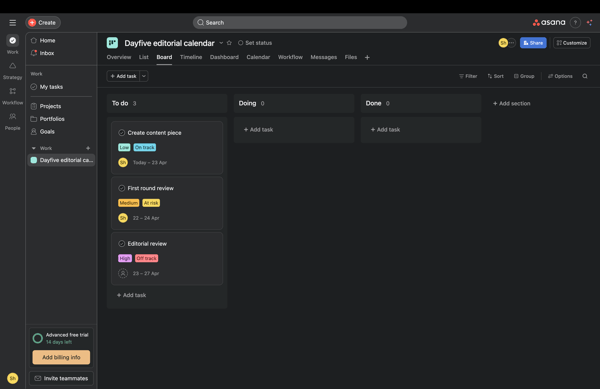
Meanwhile, Monday.com is highly visual; its colorful boards and drag-and-drop features simplify navigation, even for new users of project management tools. It’s an excellent choice for teams that want something intuitive and adaptable. You can customize almost everything, which is perfect for teams with unique workflows.
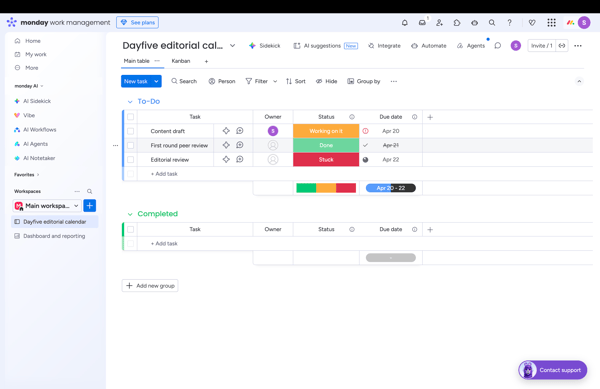
My experience was better on Monday.com for setting up the editorial planner than on Asana. I liked the UI and its color, making it easier to grasp key items quickly by just looking at it.
Winner: Monday.com 🏆
Task management
Asana shines when it comes to how detailed you can get with tasks. I broke tasks into subtasks, created dependencies so one task could start only after another one is done, and organized everything neatly with sections and tags. I found Asana’s task management to be slightly more structured.
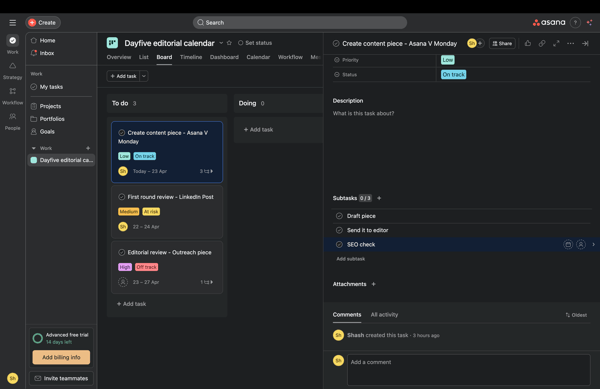
Monday.com is easier to set up and use right away; it depends on whether you value detailed control or quick customization. Monday.com is super flexible. It lets you customize your workspace with colorful boards, different views like timelines and Kanban boards, and options to track time on tasks.
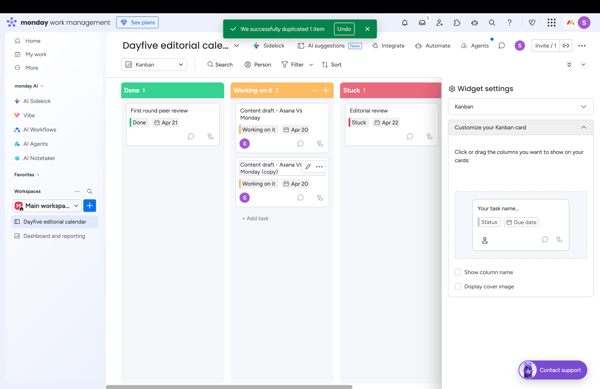
Based on my experience, I found setting up my first board on Monday.com much easier than on Asana. Asana is more detailed, encouraging you to define and measure even the tiniest things in a project. On the other hand, Monday.com offers a relatively simple interface. I was able to set up the project on Monday.com faster than on Asana.
So, Asana is a great option if you want to monitor the most minor details with sub-tasks and dependencies. Monday.com will give a good overview, but may not offer in-depth control over different tasks.
Winner: Asana 🏆
Analytics
Asana takes a more straightforward approach to analytics. I got an individual dashboard for each project with six types of charts, including bar, line, and donut charts. They offer a good overview, but lack advanced customization options. I found mixing and matching different data sources tricky when creating highly detailed reports on Asana.
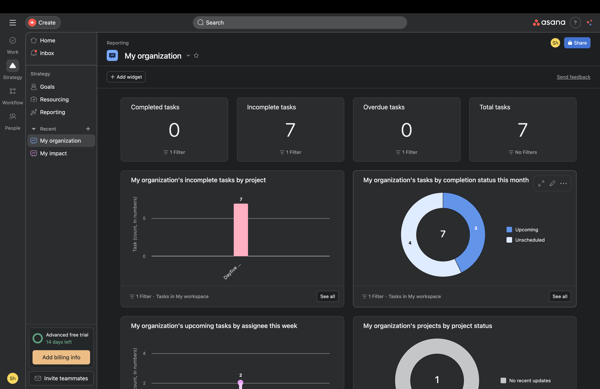
Asana’s simplicity is good for teams that need a basic reporting of their project. Asana’s analytics features are easy to use, making it more straightforward for teams with limited data visualization and reporting experience.
Monday.com, on the other hand, has a noticeable advantage as it offers over 40 dashboard widgets. They allow you to create highly customized reports. These widgets let you track everything from project progress to team workloads in an easy-to-visualize way.
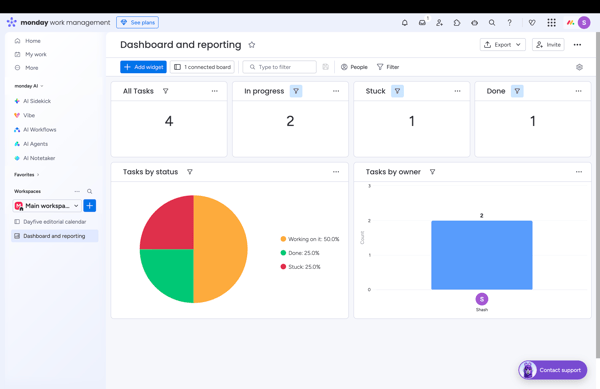
Monday.com uses a system called MondayDB to manage big, complex projects while keeping your data easy to access and well-organized. If you like customizing how your data looks, you’ll enjoy the control and flexibility Monday.com offers.
Winner: Monday.com 🏆
Integrations
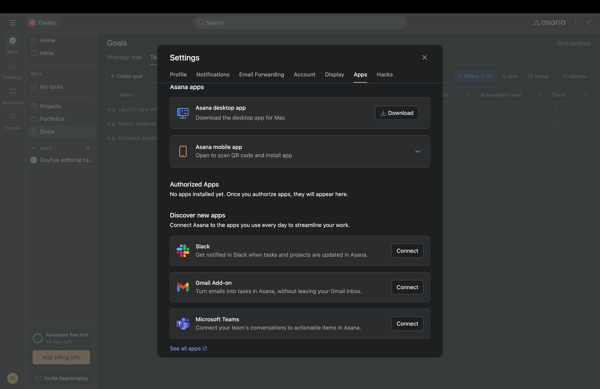
Integration allows project management tools to connect with software you already use, such as Slack or Google Drive. Asana is a clear winner in this category, as it offers over 200 integration tools. It also includes Integrations in all its paid plans, so you don’t have to pay extra to connect it to your favorite apps. This makes it versatile, especially for teams that rely on multiple tools.
Monday.com has about 81 Integrations, which isn’t bad, but it’s more limited than Plus. Some of Monday.com’s integrations are locked behind their higher-tier plans, and the number of times you can use them each month is capped.
If connecting your project management tool to other apps is critical for your team, Asana is the solution.
Winner: Asana 🏆
Workflow automation
I found Asana’s workflow automation more intuitive and suggestive than Monday.com’s. The workflow interface gives various options to automate tasks and minimize my work, keeping things organized.
For example, whenever someone submits a new task through a form, it is automatically assigned to my tasks. Or, when someone moves a task to the “Done” section, it is automatically completed (with a green check mark).
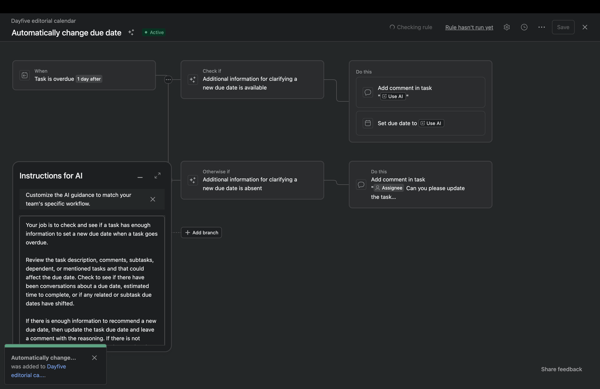
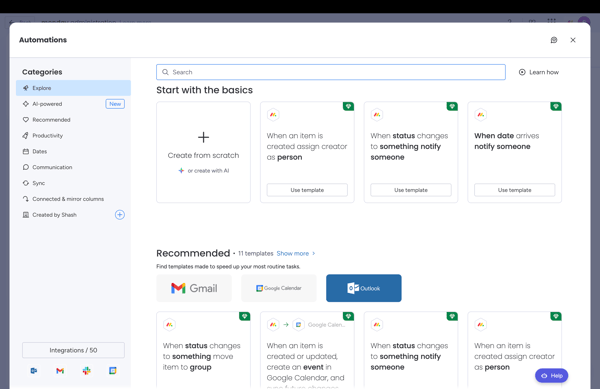
Experience-wise, it was also easy to set up basic automation in Monday.com. It allowed me to personalize the app’s notifications while including variables that would be different for every task.
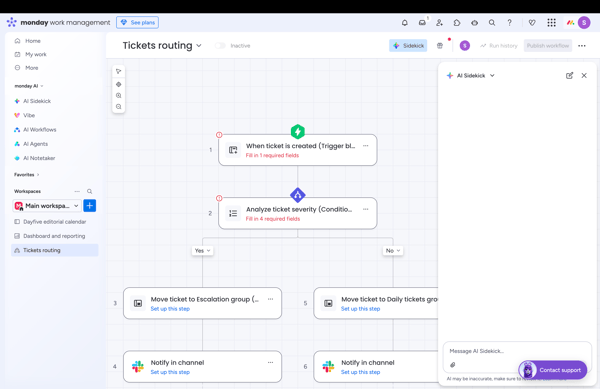
Monday.com also offers different templates, which you can use to set up various kinds of automations.
My experience with both Asana and Monday.com was equally good in the workflow automation category.
Winner: Tie
Pricing
Monday.com and Asana both offer free plans, but differ in what they include. Asana’s free plan supports up to 2 users and gives you access to basic project and task management tools. It’s great for individuals or small teams just getting started and don’t have a big budget.
The Monday.com free plan is similarly limited. It only allows two users and three boards, which might not be enough for most teams. On the plus side, Monday.com’s paid plan starts at just $9 per seat per month, slightly cheaper than Asana’s paid plans, which start at $10.99 per user per month.
Monday.com’s Pro plan costs $19 per seat per month and offers advanced features like time tracking, private boards, and more automation options. Asana’s equivalent plan is priced at $24.99 per user per month and includes project portfolios, goals, and native time tracking. Monday.com is more affordable, but Asana offers more value to teams needing those extra features.
Winner: Tie
Here’s a table showing the project management tool that wins:
| Feature and functionality | Winner | Why it won |
| Setup and user experience | Monday 🏆 | Monday.com has a much more engaging UI. Its vibrant colors make it simpler to quickly grasp overall operations simply by looking at it. |
| Task management | Asana 🏆 | Asana lets you dive in-depth into subtasks and dependencies, giving you more granular control. |
| Analytics | Monday 🏆 | It is easier to set reporting on Monday.com while the platform gives you several templates to visualize projects. |
| Integrations | Asana 🏆 | Asana has more than 200 integrations, making it a suitable team tool. |
| Workflow automation | Tie | Both Asana and Monday.com offer easy and intuitive ways to automate workflows. |
| Pricing | Tie | While Monday.com is slightly more affordable, Asana offers a broader feature set for teams on high-tier paid plans and consistently delivers value. |
Key insights on Asana vs. Monday from G2 data
I also looked at review data on G2 to find strengths and adoption patterns for Asana and Monday. Here’s what stood out:
Satisfaction ratings
- Asana has strong satisfaction scores across the board, with ease of use at 88%, ease of setup at 88%, ease of doing business with at 89%, and a likelihood to recommend of 88%.
- nday Work Management excels across all satisfaction metrics, with ease of use at 92%, ease of setup at 89%, ease of doing business with at 93%, and an impressive likelihood to recommend of 94%.
Industries represented
- Asana dominates marketing and advertising, information technology and services, computer software, non-profit organization management, and internet industries.
- mnday Work Management has a strong presence in marketing and advertising, information technology and services, computer software, construction, and non-profit organization management.
Highest-rated features
- Asana excels in creation and assignment (94%), due dates (93%), and to-do lists (92%).
- mnday Work Management stands out for creation and assignment (94%), due dates (94%), and task prioritization (93%).
Comparing more options? Read this in-depth review of Asana vs Jira and Trello vs Asana.
Frequently asked questions (FAQs) on Asana vs. Monday
Have more questions? Find more answers below.
Q1. How do I move from Asana to Monday?
Monday offers a native import tool that allows you to import data directly from Asana. Go to your profile avatar on Monday and select “Import Data”. Choose Asana as a source, connect to your Asana account, and select the projects you want to import. The system will automatically attempt to map users based on their email addresses.
You may face challenges importing subtasks, attachments, comments, or custom fields. Alternatively, you can migrate manually via CSV export and import, though this may require adjustments for subtasks and custom fields. After migrating, rebuild any automations or workflows in Monday to match your Asana setup. If the process seems complex, consider seeking expert help.
Q2. Is Asana too expensive?
Asana is slightly more expensive than Monday at the entry level, but it offers strong value for teams that need granular controls, unlimited automations, and structured project management across multiple workstreams.
Q3. Is Asana no longer free?
Asana offers a free Personal plan for up to 2 users, which includes unlimited tasks and projects, and list, board, and calendar views. Monday also offers a free plan for up to 2 users, limited to 3 boards and 3 docs with no automations or integrations.
Q4. Which tool integrates better with my existing tech stack?
Both tools connect with popular apps like Slack, Zoom, Google Workspace, and Microsoft Teams. Asana includes integrations across all its paid plans, while Monday unlocks them from the Standard plan and above. For teams that rely heavily on third-party tools, Asana offers more flexibility at lower tiers.
Q5. Which project management tool is more customizable, Asana or Monday?
Both tools offer customization, but in different ways. Monday is generally more visually customizable, with flexible boards, column types, color coding, and templates that let teams design workflows around their unique needs. Asana provides customization through structured features like subtasks, dependencies, custom fields, and portfolio management — better suited for teams that need process consistency across projects.
Q6. Is Monday more user-friendly than Asana?
Monday’s colorful, visual interface makes onboarding quick and intuitive, especially for teams new to project management tools. Asana emphasizes simplicity and structure, with a clean layout that helps users focus on tasks without distractions. Which feels more user-friendly largely depends on whether your team prefers visual flexibility or a minimalist, streamlined experience.
Q7. How does Asana compare to Monday for project management?
Both tools offer robust project management capabilities and emphasize different strengths. Asana is well-suited for teams that need structured task management, detailed dependencies, and portfolio-level visibility across multiple projects. Monday is more visually customizable and adaptable, making it a strong fit for teams that want to build workflows around how they already work. Both support multiple views, built-in collaboration, and workflow automation.
Q8. What is the difference between Asana and Monday.com for project management?
Asana is built around structured task management, with strong support for subtasks, dependencies, and cross-project visibility. Monday takes a more flexible, visual approach, using customizable boards and column types to adapt to almost any workflow. Asana suits teams that need process structure and accountability, while Monday suits teams that prioritize visual clarity and adaptability.
Q9. How do Asana and Monday.com compare in pricing and features?
Both tools offer a free plan for up to 2 users. Asana’s paid plans start at $10.99 per user per month on the Starter plan, which includes unlimited automations, timeline views, and custom fields. Monday’s paid plans start at $9 per seat per month on the Basic plan, with automations and integrations unlocking from the Standard plan at $12 per seat per month. At higher tiers, Asana’s Advanced plan at $24.99 includes goals, portfolios, and native time tracking, while Monday’s Pro plan at $19 includes time tracking, private boards, and 25,000 automation actions per month.
Q10. Is Asana or Monday better for managing team projects?
It depends on how your team works. Asana is the stronger choice for teams managing multiple projects simultaneously that need clear ownership, task dependencies, and structured workflows. Monday is better suited for teams that want a highly visual, flexible workspace they can customize to fit their processes. Both are capable tools. The right choice comes down to whether your team values structure or flexibility.
Asana vs. Monday: The final verdict
Asana excels in task management while offering detailed control with sub-tasks and dependencies. It’s easy to use and has a large number of integrations. I see Asana as a great fit in use cases where teams work on different projects and need more granular control to keep all projects running smoothly toward their goals.
Monday is suitable for teams that need more flexibility and customization. It’s visually appealing and power-packed with features like time tracking, colorful boards, and robust data visualization tools. However, its integrations are limited and locked behind higher-tier plans.
Ultimately, it comes down to what you want the most from the tool. If you want to find the best software between Asana and Monday.com, choose the one that best serves your priorities.
Want a deeper look at Monday? Read our full monday.com review for a hands-on breakdown of its pros, cons, pricing, and best use cases.
[ad_2]
Source link