

[ad_1]


The March and April 2026 drawdown has structural consequences, as Bitcoin ETF holders stayed steady.
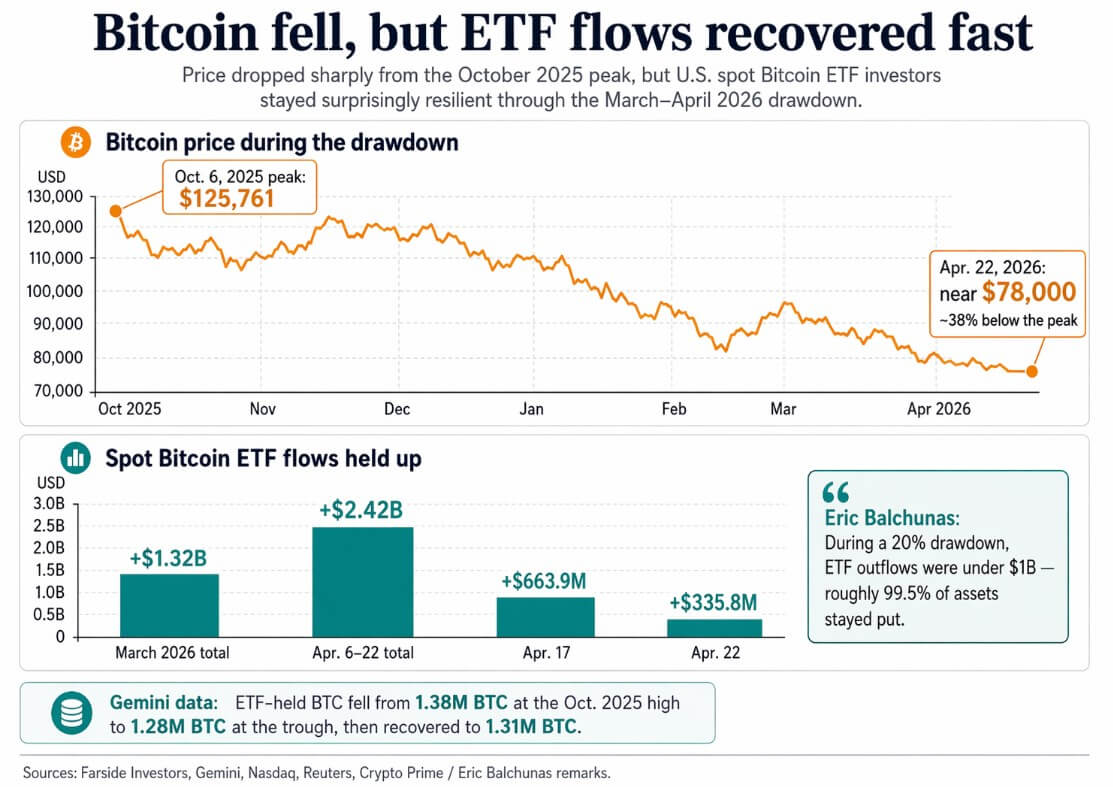
Bitcoin sits near $78,000, roughly 38% below the $125,761 peak from Oct. 6, and US spot Bitcoin ETFs pulled in $1.32 billion in March, reversing a four-month outflow streak. Then, the ETFs added another $2.42 billion in net inflows between Apr. 6 and Apr. 22.
The strongest days were Apr. 17, with $663.9 million in inflows, and Apr. 22, with $335.8 million in inflows. Gemini’s coin-level data show that ETF-held Bitcoin fell only from 1.38 million BTC at the October 2025 high to 1.28 million at the trough, then recovered quickly to 1.31 million.

During an interview with Crypto Prime, Bloomberg senior ETF analyst Eric Balchunas said that during a 20% drawdown, ETFs logged outflows of under $1 billion, roughly 99.5% of their assets. This happened during a genuinely hostile macro window.
Nasdaq’s March update showed a 21% decline in the total digital asset market cap across the first quarter, while the Nasdaq-100 fell 4.9% and the S&P 500 fell 5.1%. ETF holders absorbed all of that without producing the exit wave skeptics had forecast.
Balchunas argued that the selling pressure came from longer-tenured crypto holders, saying that the call was “coming from inside the house.”
The ETF analyst’s interpretation fits the flow data, as net ETF buying held through a historically steep drawdown while something else pushed the price lower.
A different kind of buyer
The ETF wrapper places Bitcoin inside model portfolios, advisor guardrails, committee-approved position limits, and rebalancing schedules.
Buyers inside those structures operate during regular trading hours, so the rules constrain them. In a drawdown, constraint looks like discipline.
| Buyer type | Typical wrapper | Behavior constraints | Likely drawdown behavior |
|---|---|---|---|
| Spot Bitcoin ETF holder | ETF / brokerage account | Model portfolios, advisor rules, position limits, trading hours, rebalancing schedules | More likely to hold or rebalance gradually |
| Legacy crypto-native holder | Direct coin ownership | Fewer formal portfolio guardrails | More discretionary selling |
| Leveraged trader | Perpetuals / margin venues | Liquidation risk, collateral pressure | Forced selling can accelerate |
| Corporate / treasury holder | Balance-sheet allocation | Treasury policy, liquidity needs | May sell based on firm-level constraints |
| Miner | Native BTC holdings | Operating costs, treasury needs | May sell into weakness for liquidity |
Bitwise and VettaFi’s 2026 advisor survey pointed out that 32% of financial advisors allocated to crypto in client accounts in 2025, up from 22% the year before, while 42% say they can now buy crypto in client accounts, and 77% name an ETF as their preferred vehicle.
EY-Parthenon and Coinbase’s 2026 institutional survey adds that 73% of respondents plan to increase digital asset allocations this year, 66% already access spot crypto through ETFs or ETPs, and 81% prefer registered vehicles over direct coin custody.
EY’s framing of the behavioral finding is that volatility is driving more formal risk discipline.
BlackRock reinforced its sizing logic in late 2024, recommending allocations of up to 2% for investors interested in Bitcoin, noting that larger weights can disproportionately alter overall portfolio risk.
A 2% sleeve absorbs a 38% drawdown in assets as a tolerable drag on a diversified portfolio, a math that produces slower hands.
The distribution infrastructure continues to deepen, as Bank of America opened crypto ETP recommendations to advisors across Merrill, Merrill Edge, and its Private Bank on Jan. 5, 2026.
Morgan Stanley filed for a Bitcoin ETF in January and launched MSBT on Apr. 8, and Charles Schwab announced spot crypto trading.
Each move routes more Bitcoin buying through channels in which compliance reviews, position-sizing rules, and client-agreement constraints govern execution. In these channels, discretionary panic selling is more difficult to execute.
Different cases for this behavior
The bull case holds that the ownership base has already begun to change in ways that compound over time.
As advisor and institutional access widen, Bitcoin’s marginal buyers hold small, long-duration allocations governed by rebalancing rules.
The next drawdown finds that the buyer is less likely to exit and more likely to add. The preference for registered vehicles across both advisor and institutional surveys, the modest contraction in ETF-held BTC during a severe drawdown, and the speed of April’s flow recovery all point in the same direction.
Citi’s 12-month bull scenario for Bitcoin targets $165,000, anchored in sustained institutional demand and a constructive US regulatory backdrop.
The bear case locates the limit of that argument in conditions that the recent drawdown never reached. ETF holders may prove disciplined only up to a threshold, as stop-losses trigger, margin calls hit model portfolios, and allocation bands force reductions.
In that scenario, the same rules that produced restraint on the way down accelerate selling all at once. Citi’s adverse 12-month scenario puts Bitcoin at $58,000, tying the lower end explicitly to stalled US regulatory progress, draining a primary ETF-demand catalyst.
The bear case also runs through redistribution. A more disciplined ETF buyer base may simply push Bitcoin’s volatility onto a different set of actors, including leveraged traders, perpetual futures markets, miners, and corporate treasury holders, who operate without rebalancing guardrails.
Recent ETF resilience, on this reading, reflects a benign macro window.
| Scenario | What happens to ETF holders | What happens to other holders | Market implication |
|---|---|---|---|
| Bull case | Hold steady, rebalance, possibly add | More selling comes from leveraged traders, miners, or legacy holders | Ownership mix is shifting structurally; drawdowns become more cushioned |
| Base case | Moderate outflows, but no stampede | Mixed selling pressure across crypto-native cohorts | ETFs soften volatility at the margin but do not rewrite market behavior |
| Bear case | Allocation bands, stop-losses, or macro stress trigger heavier ETF selling | Broader risk-off selling spreads across all cohorts | ETF resilience proves conditional, not structural |
| Key metric to watch | ETF-held BTC and net flows in the next 20%–30% selloff | Relative selling intensity outside ETFs | Best real-world test of Balchunas’s thesis |
The next 20%-30% drawdown is the empirical test of whether ETF-held BTC contracts sharply or flows stabilize quickly, as they did in April. A repeat of the recent pattern would move Balchunas’s interpretation closer to a documented market fact.
A wholesale ETF exit under sufficient macro stress would confirm the composition held only as long as conditions allowed.
[ad_2]
Source link