
![What Is a VoIP Phone? A Beginner’s Guide [+ Best Picks]](https://i1.wp.com/www.nextiva.com/blog/wp-content/uploads/sites/10/2019/06/Nextiva_Header_what_is_voip_phone.png?ssl=1 "What Is a VoIP Phone? A Beginner’s Guide [+ Best Picks]")
If you’ve ever made a phone call through Zoom, Teams, or a mobile app instead of a desk handset, you’ve already experienced VoIP calling — whether you realized it or not. A VoIP phone looks and feels like a regular phone, but instead of using a traditional landline, it routes calls over the internet.
That simple shift unlocks powerful features like virtual numbers, voicemail-to-email, video calls, call routing, CRM integrations, and the ability to answer business calls from anywhere. As more companies move away from outdated phone lines, VoIP phones have quickly become the modern standard for business communication — offering clearer audio, lower costs, and unmatched flexibility for remote and hybrid teams.
In this guide, we’ll walk through exactly what a VoIP phone is, how it works, and how to decide whether it’s the right fit for your business.
What Is a VoIP Phone?
A VoIP phone (Voice over Internet Protocol phone) is any device that makes and receives calls using an internet connection rather than a copper phone line. Unlike traditional desk phones that connect to a PBX or phone jack, VoIP phones connect to your network and route calls digitally. This can include dedicated VoIP desk phones, desktop softphone apps, mobile apps, or even browser-based calling tools.
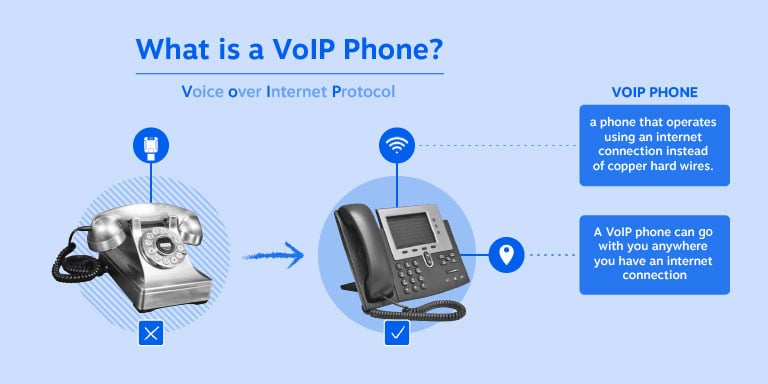
What makes VoIP phones different is how flexible they are. Your phone number isn’t tied to one physical location — so calls can ring your desk phone, laptop, or smartphone at the same time. Most VoIP phones also support advanced calling features such as call forwarding, auto attendants, voicemail-to-email, video calling, and integrations with business tools like CRM systems.
This is why VoIP phones have become the standard for remote work, distributed teams, and businesses that want modern communication tools without the limitations of landlines.

VoIP vs. Traditional Phone Systems
The biggest difference between a VoIP phone and a traditional landline telephone is that a VoIP phone is connected over the internet. In contrast, a landline phone is installed in a physical location by the local telephone provider.
On the other hand, a VoIP phone makes and receives calls over the internet and is not limited to a specific location or provider. VoIP phones enable more flexible and efficient business communications compared to traditional systems.
This way, you can use that phone number from anywhere you have internet access.
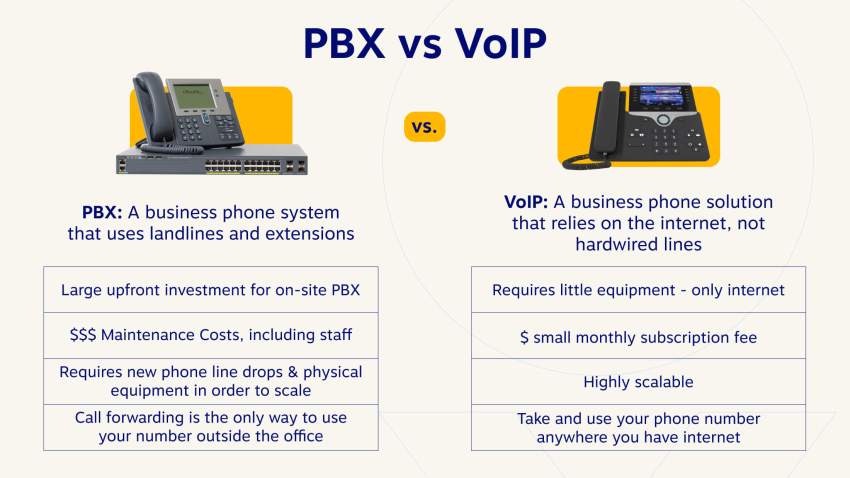
As a result, there are two significant differences in functionality between VoIP phones and traditional phones. The first is that a VoIP phone will work in any location. As long as you have an internet connection, you’ll be able to make and receive calls without being tied to one place. VoIP technology supports integrated communication tools, including voice, video, and chat, which enable seamless and reliable business communications.
And the second difference is that you don’t need a physical phone to make calls. You can make a call using an app on your computer or mobile phone.
Here’s a detailed comparison between VoIP and landline phones:
| Functionality | VoIP phones | Landline phones |
|---|---|---|
| Phone calls (PSTN) | Yes | Yes |
| Nationwide long-distance | Included | Optional |
| User-to-user calls | Yes | PBX required |
| Caller ID | Yes | Yes |
| Call waiting | Yes | Yes |
| Ease of setup | ★★★★★ | ★★★ |
| Requires internet | Yes, 100 Kbps per line | No |
| Wireless | Wi-Fi, DECT, and Bluetooth headsets are available | DECT and Bluetooth headsets are available |
| Reliability in internet/power outages | Calls can be routed to another number or voicemail. | Calls drop or are routed to voicemail. |
| Technology | IP telephony (SIP, TLS, and SRTP) HD audio quality |
Analog voice signals |
| Call quality | ★★★★★ | ★★★★ |
| Setup cost | $0 | $110 per jack |
| Monthly cost | $20–40 | $50 |
| Activation fee | $0 | $50 |
| Auto attendant | Included | PBX required |
| Phone number privacy | Included | Varies |
| Phone number changes | Included | $27 |
| Hunt groups | Included | PBX required |
| Conferencing | Included | Three-Way Calling |
| Call routing | Included | $9.95/mo |
| Call queuing | Add-on | Add-on |
| Remote work compatible | Yes, softphone apps | Call forwarding |
| Call encryption | Yes (TLS & SRTP) | No |
| International dialing | MX: $0.16/min UK: $0.01/min JP: $0.05/min |
MX: $0.54/min UK: $1.21/min JP: $1.62/min |
| Business voicemail | Included | $13.95/mo |
| Integrations (CRM, text messaging, surveys) | Yes | No |
How Does a VoIP Phone Work?
A VoIP phone places calls over the internet instead of a copper phone line. It connects to your network (via Ethernet, Wi-Fi, or an app) and links to your VoIP service provider, which handles call setup and routing.
Here’s what happens behind the scenes:
- The phone registers itself with the VoIP service. Your VoIP phone or app signs in to your provider using your account credentials. This lets the network know where to deliver calls for your number.
- You dial a number. The phone sends a digital request to the provider to start the call. If the other party also uses VoIP, the call usually stays entirely online. If the recipient uses a landline or mobile network, the call is routed through a VoIP-to-PSTN gateway so it can connect to the traditional phone network.
- Your voice becomes data. As you speak, the phone converts your voice into small compressed data packets using a codec (like G.711 or Opus). These packets travel over the internet in real time.
- The receiving phone plays the audio. On the other end, the packets are reassembled and converted back into sound — so the other person hears you instantly.
- Call features run in the background. Things like caller ID, voicemail, call recording, routing, and extensions are all managed digitally by the VoIP provider.
Because everything is transmitted online, calls can reach your desk phone, laptop, or mobile app anywhere you have an internet connection — while still using the same business number. And although several steps happen during setup and transmission, the connection feels just like a normal phone call with clear, real-time audio.
Want to know about the technology behind VoIP? Check out our beginner’s guide to SIP.
Benefits of VoIP Phone Systems
VoIP systems replace the limitations of traditional phone lines and on-site PBX hardware by routing calls over the internet. That gives businesses more flexibility, richer calling features, and simpler management — all without relying on physical phone wiring.
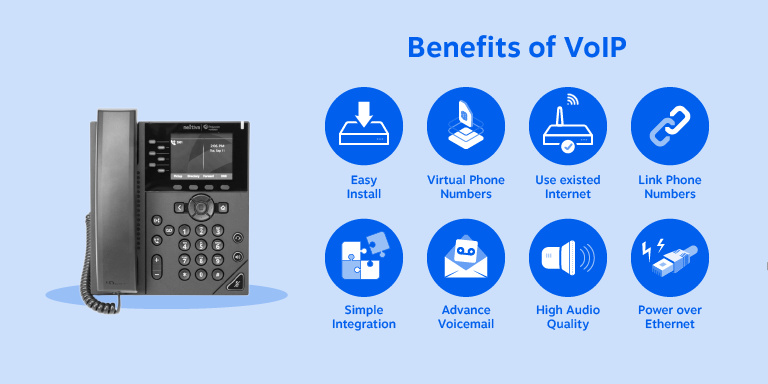
Here are the top benefits of using a VoIP phone system:
Easy setup & integration
- Simple installation with no complex wiring
- Works over your existing internet connection
- Integrates smoothly with tools like Microsoft Teams and CRM platforms
Virtual & linked phone numbers
- Use virtual phone numbers for teams or locations
- Route and link multiple numbers to specific users or departments
- Keep your existing business number when switching to VoIP
Mobility & flexibility
- Make and receive calls from desk phones, laptops, or mobile apps
- Work from anywhere with an internet connection
- Maintain the same caller identity across devices
Advanced calling features
- Visual voicemail and voicemail-to-email
- Auto attendants and smart call routing
- Bluetooth headset support and optional PoE for cleaner desk setups
Scalable & cost-efficient
- Add lines and users without technician visits
- No on-premise PBX hardware to maintain
- Lower ongoing service and maintenance costs
Clear, reliable call quality
- High-definition audio for natural-sounding conversations
- Consistent performance across supported devices
Businesses like VoIP because it’s easier to scale (vs. traditional landlines) and add phone numbers as your team grows. VoIP has easy installation: You don’t need technicians to come out to install physical phone lines — you only need an existing broadband connection and a VoIP provider.
Note: Sometimes, businesses prefer to retrofit an existing PBX to a cloud-based system rather than switching entirely to a VoIP phone system. This type of migration relies on Session Internet Protocol (or SIP trunking) to connect phone calls over IP networks. SIP is commonly used as a control protocol in VoIP technology, ensuring efficient call management and connectivity.
VoIP Phone Equipment
VoIP phone equipment generally falls into two categories: desk (wired) phones and softphones. Most businesses use one or a combination of both, depending on how and where their teams work.
Desk or “wired” VoIP phones (sometimes also called “hard phones”) are physical handsets that sit on a desk or in a conference room. They plug into your network using Ethernet (or sometimes Wi-Fi) and often include programmable keys for speed dials, extensions, and call features.
Softphones are software-based phones that run on a computer, tablet, or mobile device. With a headset or built-in microphone, users can make and receive calls from anywhere with an internet connection — using the same business number as their desk phone.
Many organizations mix these options: desk phones for offices, softphones for remote or mobile staff, and dedicated conference phones for meeting rooms. This flexibility allows teams to choose the setup that best fits their workflows while staying on one unified phone system.
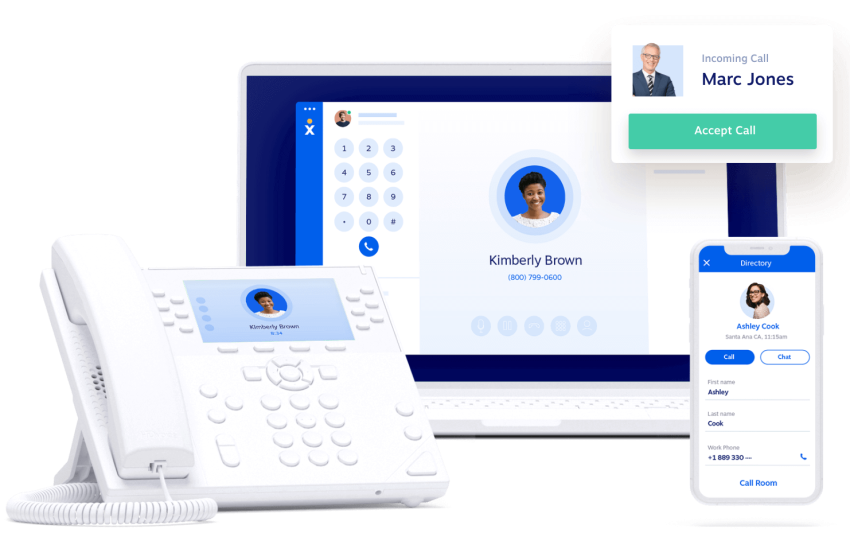
By the way, if you choose Nextiva for your cloud phone system, you will get a softphone included in your package. Nextiva also offers a variety of certified VoIP phones and equipment guaranteed to work for your needs.
Best picks for VoIP phones
We’ve assembled a chart showing the most popular VoIP phones on the market to make the decision process easy. All of these models have been tested and reviewed, and each has been benchmarked to the highest industry standards.
Remember that countless other models are available (some with either more advanced features or additional lines). Here’s a more comprehensive list of the best business VoIP phones.
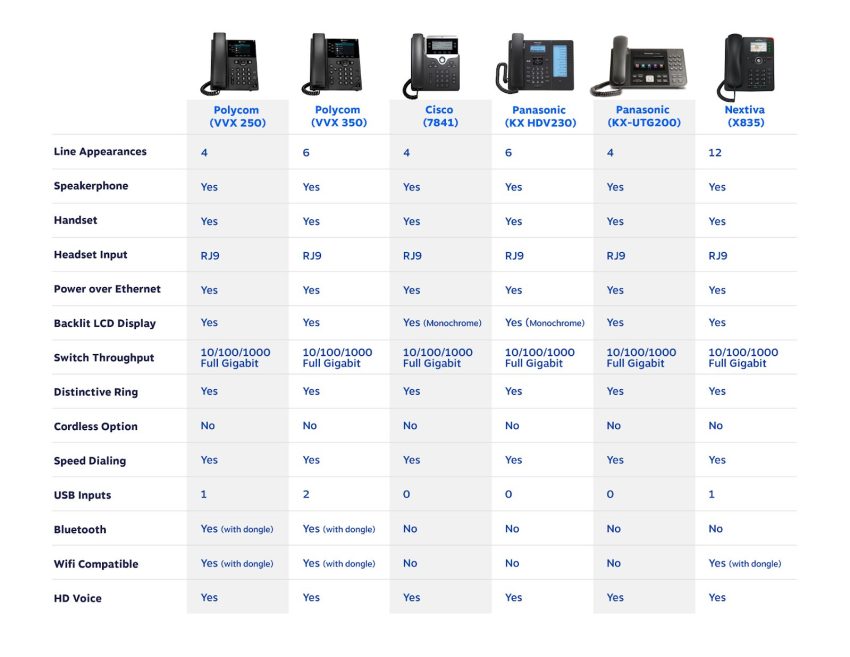
Here are our top picks for VoIP phones:
- Poly VVX 250: A high-quality, four-line, IP phone ideal for knowledge workers who need to meet today’s modern business environment demands and the ability to multitask or handle multiple calls.
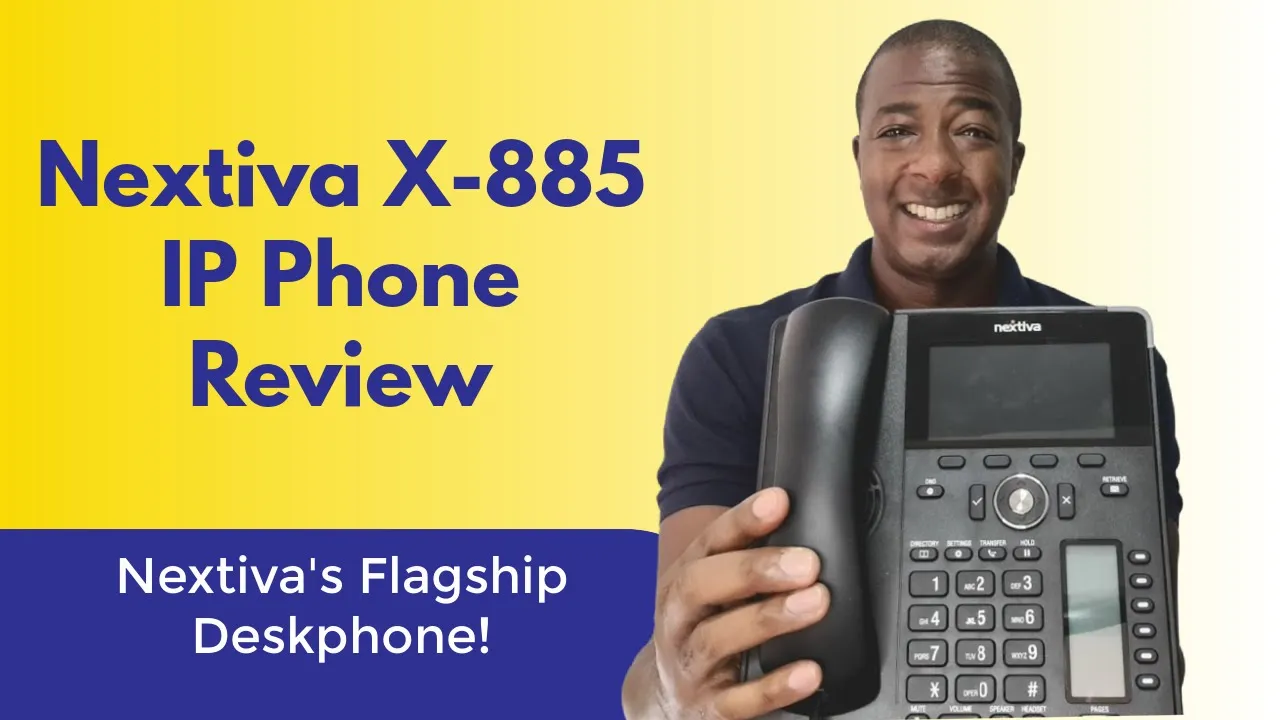
Pricing: $160 - Nextiva X-885: A sleek, twelve-line, color, IP phone ideal for executives and receptionists. It has a multi-page approach to provide twelve additional programmable keys.
Pricing: $190 - Yealink T57W: Designed for busy executives and professionals, the Yealink T57W is an easy-to-use business phone with an adjustable 7-inch touch screen. With integrated Bluetooth 4.2 and dual-band 2.4G/5G Wi-Fi, the T57W IP Phone allows for multiple wireless connection options.
Pricing: $310
Best Picks for VoIP Conference Phones
A conference phone differs from a desktop phone in that it is optimized for broadcasting high-quality sound in a group setting like a conference room because it has an omnidirectional microphone configuration.
However, there isn’t a big functional difference between desktop and conference phones. You can easily use the other if you learn how to use one.
The models shown below are among the most popular VoIP phones in the market. Each comes with standard features like speakerphones and speed dialing. For information on additional features and capabilities, refer to the chart below.
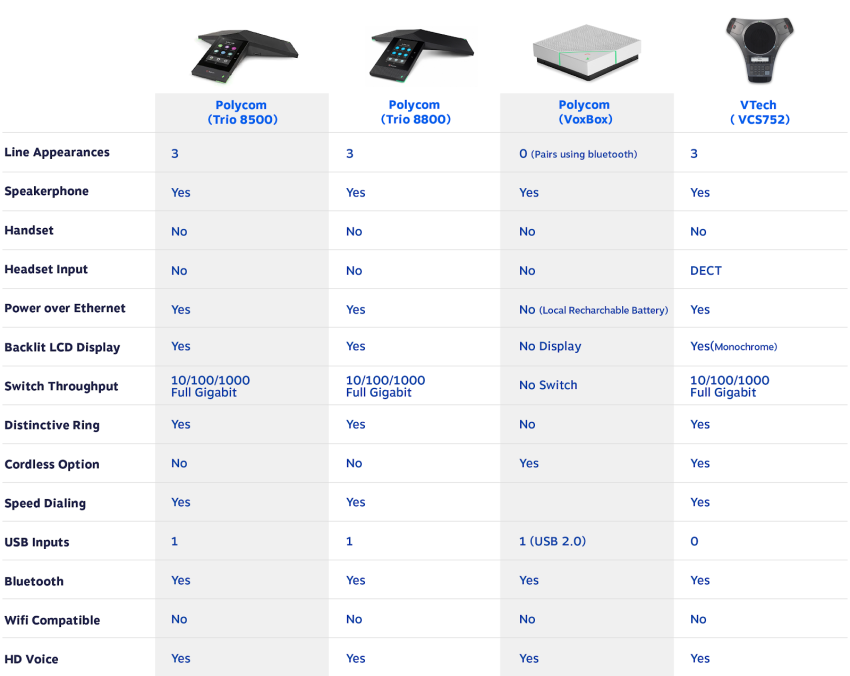
Here are our top picks for VoIP conference phones:
- Snom C520: A high-quality conference phone with 2 additional rechargeable wireless microphones to extend the vocal range and built-in noise reduction that is ideal for any conference room.
Pricing: $389 - Poly Trio 8500: A powerful conference phone with a color LCD touch screen, 14-foot optimal vocal pickup range, plus USB and Bluetooth connectivity. The Poly Trio 8500 is ideal for medium and large conference rooms.
Pricing: $740 - Poly Trio 8800: A powerful conference phone with a color LCD touch screen, a 20-foot optimal vocal pickup range, Wi-Fi, USB, and Bluetooth connectivity. The Poly Trio 8800 is ideal for large and extra-large conference rooms.
Pricing: $900
What Type of VoIP Phone Does My Business Need?
In the end, you cannot go wrong with any of these popular devices. You’ll notice that each offers the features you would expect from a phone system.
Here are the primary requirements to consider before choosing a device.
Consider the brand reputation
Think about longevity and past performance. Are there names you trust more than others? For example:
- Poly is the global leader in effective business communication with colleagues, partners, customers, and prospects. You can’t look at a serious VoIP solution without including its product line in your decision-making process.
- Cisco is a prominent name in business networks and internet infrastructure, and a leading player in the VoIP hardware market.
- Panasonic is one of the world’s leading innovators in VoIP phone business systems. Their reputation for producing high-quality electronic devices dates back decades.
- VTech is the world’s largest manufacturer of cordless phones and is well known for its electronic educational toys.
Consider the number of line registrations
How many lines does each VoIP phone in your office need to handle? Some team members will need many more than two lines. Likewise, look at how many line appearances you can see on the screen so you know if another user’s line is available.
Consider whether you use headsets
What type of connectors do they have? An RJ-9 is a familiar type of connector for telephones but is less popular. Today’s headsets use USB for connectivity. If you need Bluetooth, then make sure your device supports it. Some devices require a USB-to-Bluetooth dongle that might not be included.
Consider Power over Ethernet (PoE)
Most Voice over IP phones now support PoE, but make sure you have the power adapters, since most employees working from home do not have PoE-capable network equipment. Cloud VoIP services simplify management, enabling faster onboarding and easier user management, which is especially beneficial for remote or hybrid work setups.
Don’t forget about reliability
Does the phone receive regular security updates? VoIP phones that receive these updates tend to be more reliable than devices that need firmware delivered by hand. (Hint: Many, many internet-connected devices never get updated.)
Growth Starts With Reliable Communications: Nextiva VoIP
Behind every sale, support call, and team discussion is one constant: your phone system. When your business depends on staying connected, a flexible VoIP platform means that your team can communicate from anywhere, scale as you grow, and deliver a consistent experience to every customer.
With a modern VoIP solution, you can easily add users, launch call centers, manage routing, and integrate your communications with the tools your team already uses — all without complex hardware or technical hassles.
Choosing the right provider makes all the difference. Nextiva offers secure, reliable VoIP service with business-ready features, easy setup, and expert guidance every step of the way. Most businesses are up and running in minutes with preconfigured desk phones or the Nextiva app on their computers and mobile devices.
If you’re ready to upgrade your phone system, speak with a Nextiva specialist to design the setup that fits your team today — and supports your growth tomorrow.
The best VoIP phone system for businesses.
Get a complete business phone system with advanced features and superior call quality for less. Nextiva is named the Best VoIP Phone System by U.S. News.
VoIP Phone FAQs
Got questions about VoIP? Don’t worry. You’re not alone. Here are our answers to the most frequently asked questions about VoIP phones.
Yes, you can transfer phone numbers from your current or even previous phone service. With Nextiva, you can transfer your phone numbers to our VoIP phone service through a straightforward number porting process.
Provide your current business phone number and account details, and we’ll handle the rest, coordinating directly with your previous carrier. We recommend keeping your old service active until the transfer completes to avoid any disruption. This ensures your contacts keep reaching you without any interruptions. For more details, see our guide on how to port your number to VoIP.
Yes, VoIP can support business SMS texting, allowing you to send and receive text messages directly from your desktop and mobile apps. This integrated texting capability helps you communicate efficiently with customers and colleagues, all within one platform like Nextiva. However, you must also register your numbers to send text messages using a process known as 10DLC.
Nextiva also supports multimedia messages for pictures, audio, and video. If you want to text from your desk phone or app, Nextiva makes it easy. Learn more about texting with VoIP.
Yes. Most VoIP desk phones use standard protocols like SIP, so you can switch your VoIP provider without replacing your physical phones, as long as the new provider supports your device. Changing providers involves updating your phone’s configuration with new credentials, giving you the flexibility to choose the best service and features for your business without extra hardware costs.
Check out our article on tips for selecting a VoIP provider for more guidance.
Setting up a VoIP phone system is easy. First, ensure you have a reliable high-speed internet connection. Then, choose a Nextiva plan that fits your business needs and sign up. Connect your VoIP phones to your network or install Nextiva’s softphone app on your computer or mobile device. Use our intuitive web portal or mobile app to configure call routing, voicemail, and other features.
Our expert support team is available to guide you through setup and ensure your system runs smoothly.
VoIP phones with Nextiva deliver significant advantages: lower costs on long-distance and international calls, complete mobility to make and receive calls anywhere with internet, and advanced features like voicemail-to-email, video conferencing, call forwarding, and integrations with your email or CRM software. The call quality is sharper and truly is in high definition so that everyone can hear you clearly.
Our cloud-based system scales effortlessly as your business grows, eliminating costly hardware upgrades. The primary consideration is ensuring a stable internet connection for optimal call quality.
With Nextiva’s network reliability and optional backup solutions, disruptions are minimal. Security is robust, with encrypted calls and continuous monitoring to protect your communications.
No. With Nextiva, you can use physical VoIP desk phones or one of the best VoIP apps available for your desktop or mobile devices. These VoIP-specific apps, also called softphones, enable you to make and receive calls using your computer or smartphone without requiring additional hardware.
However, many businesses prefer dedicated VoIP phones for their ease of use, dedicated features, and professional appearance.
Practically speaking, no. To connect calls to the public switched telephone network (PSTN) and manage phone numbers, you need a VoIP service provider like Nextiva.
While it is technically possible to run your own VoIP server, as is the case with 3CX, it requires significant technical expertise and infrastructure. Nextiva’s fully managed service handles call routing, number management, security, and support, providing a reliable and hassle-free experience.
But if you want to set up your own PBX, you can — but be sure to connect it to a top-rated SIP trunk provider like Nextiva.
VoIP phone systems are designed with security, especially if they run on Nextiva. We use industry-standard encryption protocols like TLS and SRTP to secure your calls and data. Our platform employs firewalls, secure authentication, and continuous monitoring to prevent unauthorized access and cyber threats. We also provide regular software updates and security best practices to keep your communications safe.
Choosing Nextiva means selecting a trusted provider dedicated to safeguarding your business communications. Learn more about VoIP security.