

[ad_1]
When I evaluate phone systems for a business, I start the same way every smart buyer does: I read the reviews.
If you’re looking at business phone services, AT&T may be on your shortlist, especially since it’s one of the most recognized names in telecommunications, with over 150 years of brand history. While its reputation carries real weight, when you actually dig into what AT&T customers are saying, a more complicated picture emerges.
Here’s what I found (backed by personal industry experience): Reviewers consistently praise AT&T’s network reliability and call quality. However, they just as consistently report billing errors that drag on for months, customer support that doesn’t actually feel supportive, pricing that doesn’t match what the sales representative promised, and a product that hasn’t kept pace with what modern cloud-based VoIP platforms deliver.
So if you’re considering AT&T’s business phone services, read on. This is not an attack on AT&T. In fact, it’s the exact opposite. It’s an honest breakdown of what real AT&T customers are saying, including the good, the bad, and the patterns across every major review platform. If AT&T is on your shortlist, read this before you sign anything to make sure you’re happy with your decision.
What Is AT&T Phone for Business? A Quick Overview
AT&T offers multiple business phone products. The distinctions matter, and a lot of buyers don’t realize they’re evaluating different options.
Here’s a quick overview:
- AT&T Phone for Business: This phone service connects to your existing analog phones and supports up to six phone lines. It includes more than 30 calling features but requires bundling with AT&T Business Fiber for pricing to start at $15/line/month. The actual price starts at $85 per month once you account for the fiber bundle.
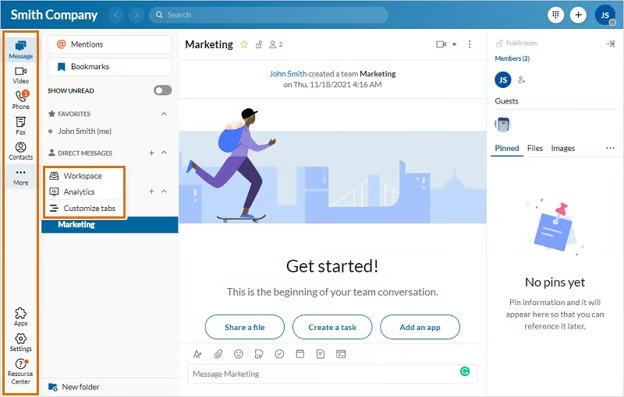
- AT&T Office@Hand: A UCaaS product that includes voice, video conferencing, team messaging, and fax. Multiple price points are available, but the product starts at $25/user/month. This is AT&T’s cloud communications product, which is distinct from Phone for Business.
- AT&T Business Voice: This service either converts legacy phones to digital voice lines or traditional analog utility lines to digital connectivity. This option has more than 40 advanced features and starts at $25 per month for voice lines and $60 per month for utility lines.
- Webex Calling with AT&T: AT&T Cloud Voice is an enterprise-grade cloud PBX that is integrated with Cisco Webex. It’s designed for larger organizations that need global calling, collaboration tools, and compatibility with legacy phone hardware.
- SIP Trunking and enterprise services: AT&T also offers SIP trunking for businesses with on-premises PBX systems, IP toll-free services, and voice transformation consulting for enterprises migrating off legacy TDM/ISDN systems.
One important note: Many customer reviews conflate these products. A reviewer complaining about AT&T’s lack of video conferencing may be reviewing Phone for Business, which was never designed to include it. This article focuses primarily on AT&T Phone for Business and AT&T Office@Hand, which are the products that small and mid-sized business users most commonly review.
What Reviewers Like About AT&T Business Phone
I’m all about giving credit where it’s due, and AT&T has some significant advantages. These are the genuine strengths that appear consistently across AT&T’s business phone reviews.
Network reliability and call quality
AT&T’s network infrastructure is one of its core advantages. Reviewers on Gartner and TechRadar consistently cite strong call quality and reliable connectivity, particularly for businesses in AT&T fiber service areas.
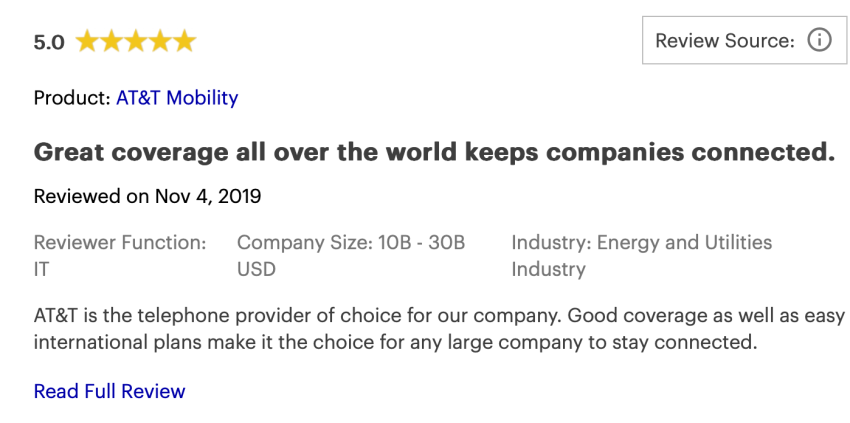
This may be helped by the 5G backup feature for AT&T Business Fiber, which provides automatic failover connectivity.
Call quality and reliability do matter, especially when the cost of missed calls is so high, which is a major reason so many customers are drawn to AT&T.
Office@Hand flexibility
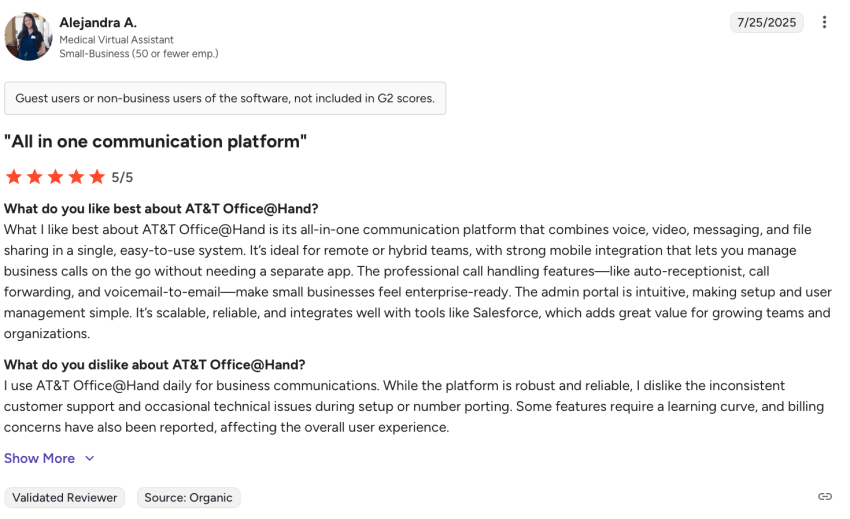
Reviewers who use AT&T Office@Hand (the RingCentral-powered UCaaS product) generally praise its flexibility for working across devices, including smartphones, tablets, desktops, and desk phones. Office@Hand includes video conferencing, team messaging, and integrations with Google, Zendesk, Microsoft 365, and Salesforce (on Premium and Enterprise plans).
Brand trust and enterprise reputation
While not many reviews cite this outright, there’s an implied trust with the AT&T brand across reviews and Reddit threads. AT&T’s 150-year track record gives it credibility, particularly with enterprise buyers and businesses that value vendor stability. That kind of reputation matters.
Single-vendor simplicity (in theory)
For businesses already on AT&T internet and mobile phone plans, adding AT&T business phone service means a single vendor, bill, and point of contact for your connectivity. In practice, billing complexity may detract from this (more on that in a moment), but it’s appealing to some customers who want to minimize vendor management.
What Reviewers Don’t Like About AT&T Business Phone
While the above sounds promising (and it can be!), it’s always important to read the cons before making a decision.
This is where the patterns become hard to ignore, because the reviews below aren’t isolated complaints that pop up just a few times. They repeat across multiple review platforms and even show up in discussion threads, like Reddit. Many of them show up across both business and personal AT&T customers.
Billing errors and pricing complexity
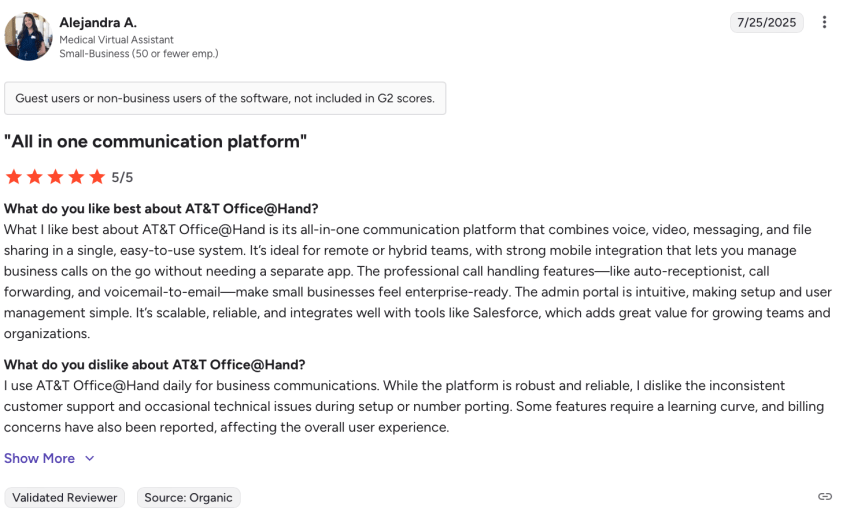
Billing errors and pricing complexity were one of the top complaints I surfaced across AT&T business phone reviews. Multiple platforms had reviews describing billing errors that persisted for months, and several reviews even reported that AT&T acknowledged errors but failed to issue refunds.
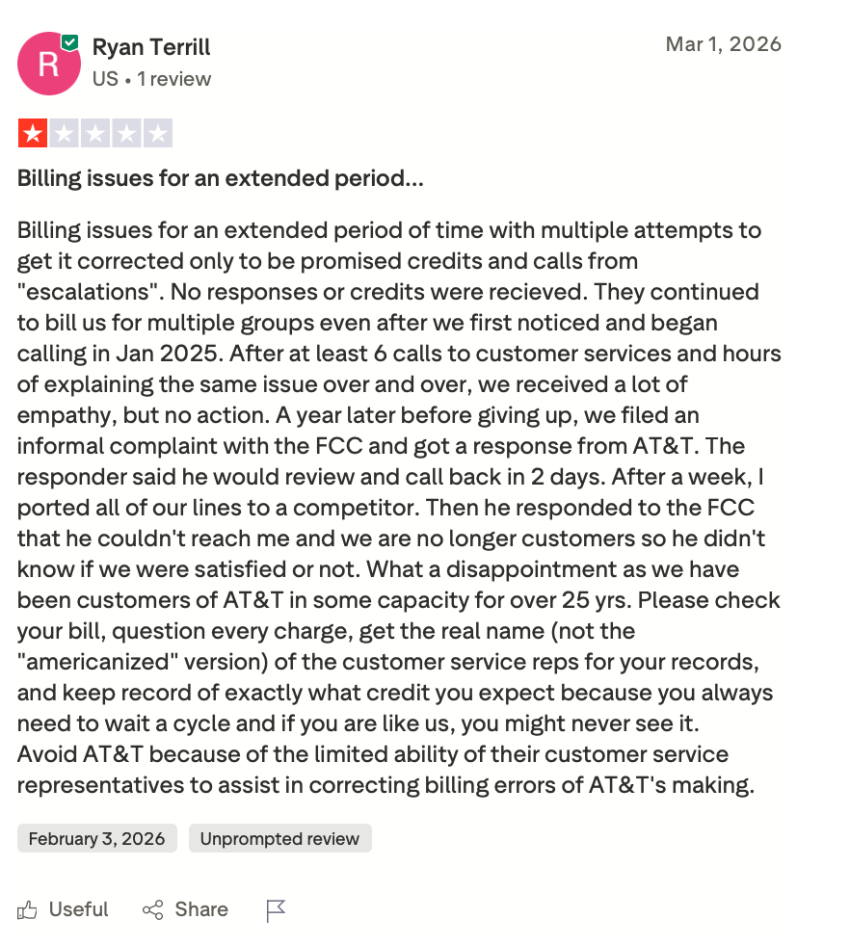
In one example, a customer claimed that billing issues lasted for an extended period, during which they were promised credits and calls from escalations. None were ever received. They ultimately filed an FCC complaint and finally received a response.
It doesn’t help that the bundled AT&T business phone pricing is confusing. While it’s $15 per line per month, the true cost starts at $85 per month for a single line once you bundle it with the Business Fiber plan.
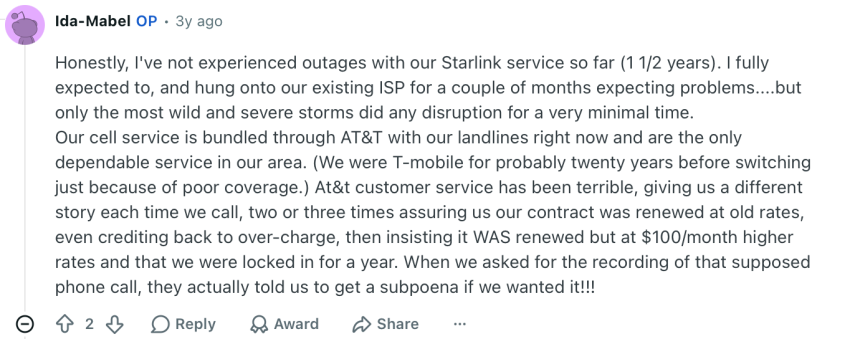
Some reviewers even reported being quoted one price by sales representatives and receiving bills for significantly more, sometimes $50-$100/month higher than promised.
Customer support challenges
Support quality is the second most common complaint I encountered, and that matters for business phone apps. Reviewers described long hold times, repeated transfers, and representatives who were unable to resolve issues.
Multiple users reported that support calls were not documented in the system, forcing them to re-explain issues from scratch across multiple calls with no resolution. I also saw several reviews saying customers were promised callbacks or escalations that never materialized.
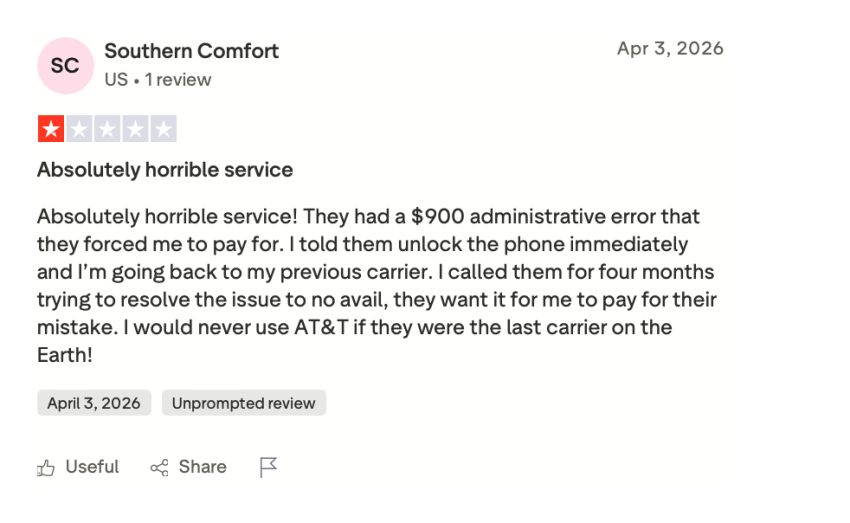
Even customers who had mostly positive things to say about AT&T’s business services cited poor customer service experiences, which is particularly notable. While most businesses will have a negative review here or there regarding customer support, it’s uncommon for otherwise happy customers to complain about it. That’s a red flag to pay attention to.
Hidden fees and cancellation difficulties
Several reviews noted that the cancellation process was difficult and expensive.
One Trustpilot review said that after months of ongoing issues and pricing disputes, they were told that canceling would cost $244. But then, several months later, they were told they’d need to pay over $700 for “free” iPhone equipment, which had never been disclosed. AT&T then refused the return of the equipment and failed to provide written confirmation of termination.
Limited features compared to modern cloud VoIP
AT&T Phone for Business is a voice-only product. There is no video conferencing, business SMS, team messaging, CRM integrations, or mobile VoIP app included. There are also no AI features, like smart call routing or an advanced AI receptionist.
The six-line limit on AT&T Phone for Business also leaves no room for growth. Businesses that need to scale beyond six lines must migrate to a completely different product.
Office@Hand addresses some of these gaps, but it is a separate product with its own pricing, creating confusion for buyers who assumed AT&T’s phone service included modern UCaaS features.
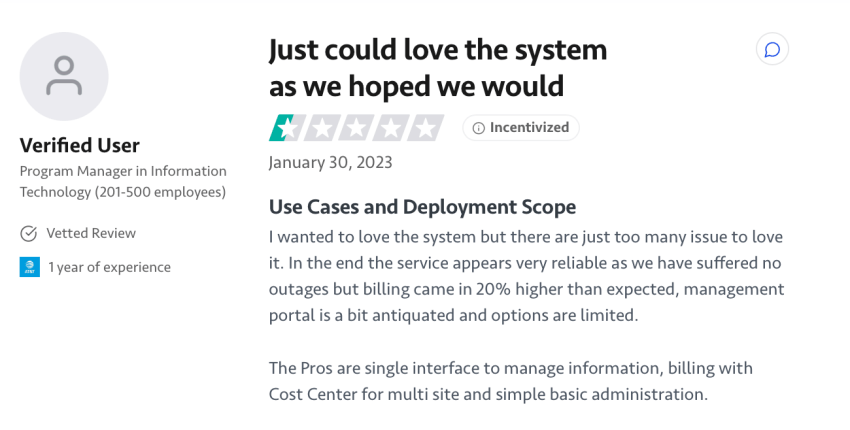
However, many modern VoIP alternatives today come with advanced features across multiple pricing tiers — often at more comparable prices than the $85-per-month starting price for the Phone for Business option. Multiple customers noted that some features were limited or that the interface felt antiquated. This is ultimately a usability issue that can prevent scalability.
AT&T Business Phone Reviews by Platform
Here’s a consolidated view of how AT&T’s business phone products are rated across major review platforms as of April 2026:
| Platform | Rating | # of Reviews | Key Themes |
|---|---|---|---|
| Trustpilot (Business) | 2.2/5 | 12 | Billing errors, support failures, cancellation difficulties |
| TechRadar | Mixed | Editorial | Reliable service, broad options, opaque pricing |
| Gartner | 4.6/5 | Varies | Good coverage and reliability, support, and service degradation noted |
| GetVoIP | 4/5 | 5 | Easy to use, long hold times, support push-back on issues |
| ConsumersAdvocate | 7.9/10 | Varies | Simple setup, light on features, support warnings |
One thing to note: AT&T’s business phone products have relatively few dedicated reviews compared to cloud-native competitors. That’s consistent with a legacy product that generates lower organic engagement on review sites, and something to factor in when weighing the data.
What to Look For in a Business Phone System (Beyond Reviews)
Before making any decision based on reviews alone, here’s the framework I recommend customers use when evaluating business phone systems:
- Transparent pricing: The monthly price should be clear — no mandatory bundles, no hidden fees, no equipment charges that surface after you sign. If you can’t find the price on the website, that’s a red flag.
- Unified communications: A business phone system in 2026 should include voice, video, SMS, and team messaging in one platform. Voice-only products force you to bolt on additional tools, increasing cost and vendor complexity. That’s the definition of tool sprawl.
- AI and automation: Smart call routing, AI voicemail transcription, and AI receptionists are table stakes now. If a platform doesn’t offer them, you’re starting behind.
- Scalability: A six-line limit is a scalability ceiling. Determine if the platform can grow from five users to 50, then to 500, without hitting a wall or requiring a migration.
- Reliable customer support: 24/7 phone, chat, and email support matters, especially during setup or migration and when billing issues arise. Look for providers with a documented track record of support, not just a phone number on a website.
- Published uptime SLA: Up to 99.999% uptime means less than six minutes of downtime per year. If a provider doesn’t publish an uptime guarantee, ask why.
- CRM and tool integrations: Your phone system should connect natively to your CRM, helpdesk, and productivity tools without requiring expensive add-ons or custom development. Routing calls through context-blind systems costs you deals and customers.
- Mobile-first experience: A full-featured mobile app lets your team handle phone calls, manage voicemail, and access their phone number from any mobile phone or device.

Nextiva vs. AT&T Business Phone: A Side-by-Side Comparison
Nextiva is one of the most popular business voice products (and AT&T alternatives) for small and medium-sized businesses in 2026. Here’s how the two platforms compare across the areas that matter most, including the exact issues that dominate AT&T’s review record:
| Feature | AT&T Phone for Business | Nextiva |
|---|---|---|
| Starting Price for VoIP cost | $85/mo. (bundled with fiber) | $15/user/mo. (billed annually) |
| Contract Required | No (month-to-month, but some reviews noted unexpected cancellation costs) | No (month-to-month available) |
| Unlimited Calling | U.S., Canada, Mexico | U.S. and Canada |
| Video Conferencing | Not included | Included (all plans) |
| Team Messaging | Not included | Included |
| Business SMS | Not included | Included |
| CRM Integrations | Not native | Outlook, Google, Salesforce, HubSpot (add-on) |
| AI Features | None | AI voicemail, voice agent, smart routing, XBert AI ($99/mo.) |
| Mobile App (VoIP) | Separate product (Office@Hand) | Included (NextivaONE) |
| Uptime SLA | Not published | Strives for 99.999% |
| Max Users/Lines | Six lines | Unlimited |
| 24/7 Support | Technical repair | Phone, chat, email (U.S.-based) |
| Trustpilot Rating as of April 2026 | 2.2/5 (Business) | 4.7/5 |
There are a few things I want to flag here:
The most common complaints in AT&T’s reviews — billing errors, support failures, hidden fees — are areas where Nextiva consistently earns high marks. Nextiva’s transparent pricing starts at $15/user/month with no mandatory bundles, no AT&T fiber requirement, and no surprise charges after the first bill.
AT&T Phone for Business gives you phone lines. Nextiva gives you a full communications platform that includes voice, video, SMS, team messaging, a mobile app, and AI voicemail transcription. And that’s all included from day one, with no add-ons required.
Next, AT&T is limited to six lines. Nextiva scales from one user to an enterprise with no line limits and no product migration required as your business grows.
Nextiva includes an integrated AI receptionist. XBert answers calls, books appointments, and qualifies leads around the clock, all starting at $99/month. That’s a capability AT&T doesn’t offer at any price point in its Phone for Business or Office@Hand lineup.
Finally, Nextiva’s 24/7 U.S.-based support directly addresses the support frustrations that define AT&T’s review record. U.S. News named Nextiva the best business phone system for four consecutive years.
When AT&T Business Phone Might Still Make Sense
Despite the negative reviews, there are scenarios where AT&T is a solid choice depending on specific business needs, as long as you get clear terms in writing. Their remote office phone systems may be a fit for:
- Brick-and-mortar businesses already on AT&T Business Fiber that want to add basic phone lines with minimal setup and no new hardware, and genuinely don’t need anything beyond a reliable dial tone.
- Legacy equipment users, such as businesses that rely on analog fax machines, alarm panels, or POS systems that require a traditional landline VoIP connection over fiber.
- Very small operations with one or two phone lines in AT&T fiber service areas that do not need video conferencing, business SMS, team messaging, or AI features.
- Large enterprises in the AT&T ecosystem that want Webex Calling with Cisco collaboration tools and already have the infrastructure and bandwidth to support it.
- Mission-critical connectivity needs or businesses that value the automatic 5G backup feature for failover during AT&T fiber outages.
Even in these scenarios, the long-term cost, feature trajectory, and customer support experience documented in real reviews favor a cloud-based VoIP service built for where business communication is actually going.
AT&T’s Review Patterns Point to a Better Alternative: Nextiva
Reviews tell you what a company’s existing customers experience every day. When the most consistent themes across AT&T’s business phone reviews are billing errors, support frustrations, and missing features, that’s a signal instead of an anomaly. When it comes to corporate phone systems, it’s essential to pay attention.
Having evaluated AT&T’s business phone products and read through dozens of real customer reviews, it is clear that AT&T’s brand reputation is strong, and its network reliability is solid.
However, its phone products haven’t kept pace with what businesses actually need in 2026. They have a voice-only VoIP service, a six-line limit, no real AI functionality, no true virtual receptionist features, and a support experience that drives some customers to the FCC. These are major structural limitations that compound over time and drive customers to look at other VoIP apps.
For teams that need transparent pricing, unified communications, AI-powered features (like AI answering services), real scalability, and support that actually picks up the phone, Nextiva delivers on every front.
Nextiva’s Core plan starts at $15/user/month and includes voice, video, SMS, team messaging, a mobile app, and AI voicemail transcription. There’s no required fiber bundle, hidden fees, or six-line limit. For businesses that want 24/7 AI call handling, AI receptionist XBert answers every call, starting at $99/month.
The reviews have spoken. Get everything AT&T Phone for Business is missing, starting at $15 per user per month with Nextiva. Try it today.
Elevate your brand with the best business phone system.
With many advanced features at no extra cost, such as a toll-free number, auto attendants, team messaging, and email integrations, this is the unified communications solution every small business needs.
Frequently Asked Questions About AT&T Business Phone Reviews
Whether AT&T Phone for Business is any good depends on what you need.AT&T Phone for Business delivers solid call quality and reliable connectivity for businesses in AT&T fiber service areas. But it’s a voice-only VoIP service with a six-line limit, no video conferencing, no business SMS, and no AI features.
For businesses that need a full communications platform, it falls short of what modern cloud VoIP services offer.
Customer reviews are consistently critical of the business service’s phone support. Common complaints include:
– Long hold times
– Repeated transfers
– Calls that weren’t documented in the system
– Escalations that don’t happen
As we mentioned above, multiple reviewers describe filing FCC complaints after months of unresolved billing issues and six or more calls to customer service. For this reason, many switch to AT&T business phone alternatives instead.
AT&T Phone for Business advertises $15/line/month, but that rate requires bundling with AT&T Business Fiber, starting at $85/month. A business with three phone lines will pay $130 or more per month before taxes and fees. Multiple reviewers also report being billed significantly more than their sales rep quoted, sometimes $50 to $100 per month over the promised price.
AT&T Phone for Business is a basic VoIP phone service. It’s voice-only, limited to six lines, has no mobile app, and doesn’t include video conferencing.
AT&T Office@Hand is a separate UCaaS product that includes voice, video, team messaging, and fax. They are different products with different pricing, different functionality, and different target customers.
For many businesses, yes, Nextiva is a better solution than AT&T’s business phone service.
Nextiva includes voice, video, SMS, team messaging, a mobile app, AI voicemail, and 24/7 U.S.-based support. It starts at $15/user/month, with no fiber bundle required.
AT&T Phone for Business is voice-only, limited to six lines, and requires a fiber internet plan. Nextiva’s Trustpilot rating is more than double AT&T’s.
Yes. You can keep your phone number if you switch from AT&T to Nextiva. Nextiva supports number porting, so you can transfer your existing business phone number when you make the switch. Nextiva’s support team handles the process, which typically takes a few business days.
AT&T Phone for Business does not include video conferencing. While AT&T Office@Hand (their separate UCaaS product) does include it, it’s a different service starting at $25/user/month.
For small and mid-sized businesses, Nextiva is the strongest alternative to AT&T’s business phone service. It delivers everything AT&T Phone for Business doesn’t, including video, SMS, team messaging, AI features, scalability, transparent pricing, and 24/7 U.S.-based support. Access all these features in a single cloud-based platform, starting at $15/user/month.
[ad_2]
Source link